Who builds Motily
Bosco Foulsham writes the code, the copy and the emails. When you write to hello@motily.app, the reply comes from him. Motily is run from the United Kingdom and your data lives in a London data region; the privacy policy names him as the data controller, which is the legal way of saying the buck stops with one person.
Nobody at Motily gives medical advice, and the site does not yet have a medical reviewer. That matters for how you read it: everything here is a plain-language summary of published research, with the source next to the claim, and nothing here is a diagnosis or a treatment plan. When a medical reviewer joins, their name and credentials will appear on the pages they have reviewed, and only on those. Until then the byline says "Written by the Motily team" and no more.
Why it exists
Around half of couples' fertility difficulties involve a male factor, and yet most of the advice, apps and attention go to women. What men get is a semen analysis result, often with little context, and a list of things to "avoid". Motily starts from a different place: sperm are made continuously, on a cycle of roughly 74 days, and the habits you keep during those days shape what gets made. That turns a vague list into a routine with a timeframe.
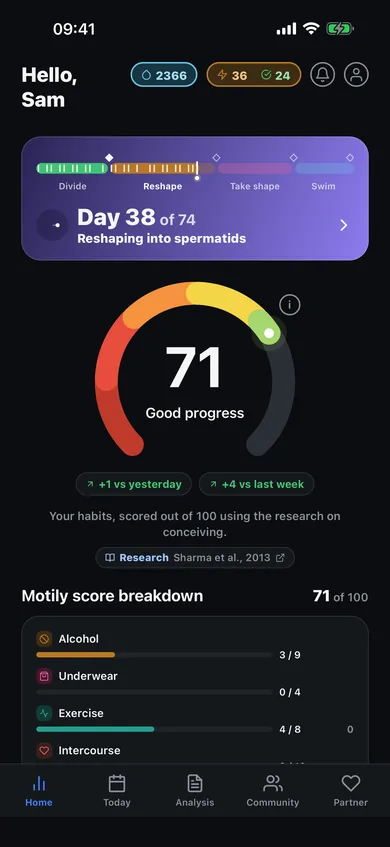
So the app is a two-minute daily check-in across the eight habits with the best evidence behind them, a score that shows where the points are, and a 74-day journey with a mascot called Remy to keep it human. It supports and informs. It never promises an outcome, because nobody honest can.
How the science is checked
The rules are written down in the editorial policy. The short version:
- Every health claim has a source you can open. A DOI, a WHO or NHS page, or a professional body's guidance, linked next to the claim. Meta-analyses and committee opinions are preferred to single studies.
- WHO 2021 is the reference for semen numbers. Reference limits on this site and in the app come from the WHO laboratory manual, 6th edition, and are labeled as reference limits, never as a line between fertile and infertile.
- Hedging is deliberate. Most of the evidence on lifestyle and sperm is observational, so the copy says "is linked to" and "may", and says when the evidence is mixed or thin.
- Quarterly review. Every guide, the science page and the FAQ are re-read against their sources at least every three months, and each page shows the date it was last updated.
- Corrections are public. If something is wrong, it is fixed and the page's update date changes. Report an error by emailing hello@motily.app with "Correction" in the subject.
How Motily makes money
Nothing during the launch period. After it, the plan is a free tier that is genuinely usable and a Premium subscription for the deeper features, paid through the App Store. There are no ads and no data selling. Motily measures nothing itself. Where we link to a test made by someone else, we label it, and some of those links earn us a commission; a commission never changes what the app or this site says about a product. Where the site compares products, such as at-home sperm tests or other apps, it says so at the top of the page and links to the sources it used.
Contact
Email hello@motily.app for anything: a question about the science, a correction, a press request, or a feature you wish existed. Replies usually take a day or two.