Eleven tests you can take without a clinic visit, from a $49 yes-or-no count strip to a $495 lab analysis with DNA fragmentation: what each measures, costs, where it ships, its regulatory status, and how long you wait.
Updated . Prices and specifications were checked against each maker's own site on 29 September 2026, Mate Health's on 4 October 2026, ExSeed's on 5 October 2026 and every kit again on 7 October 2026, unless a source says otherwise.
The short version: home sperm tests come in three tiers. Count-only strips (SpermCheck) answer one question, is concentration above 20 million per mL, in ten minutes. Phone or reader devices (YO, Bird&Be, ExSeed) add motility, and ExSeed volume, and give figures in 15 to 20 minutes; Labcorp's rapid test sorts concentration and volume into bands in under an hour. None measures morphology. Mail-in lab kits (Fellow, Legacy, Malebox, Mate Health, Ro) are a semen analysis in an accredited lab, with morphology on every kit except Legacy's Basic tier and sometimes DNA fragmentation, for about one and a half to five times the price and a wait of up to two days after the sample arrives.
Our ratings, and which test is best for what
We rate each test against others of the same type, because a mail-in lab and a phone device do different jobs: a lab analysis measures more, a home device answers in minutes. Every test gets a score from 1 to 5 on the same three things, and its rating is the average. Price isn't in the score; it's in the table and in the best value picks.
Top picks
Best home test, UK and EURated 5.0 / 5
ExSeed Home Sperm Test
Volume, concentration, motility and total motile count on your phone, about 15 minutes after the sample rests for 20. CE-IVD marked, delivered to the UK and EU.
£85.50 for 2 tests with code MOTILY (£94.99 without; checked 8 October 2026)
Get ExSeed, 10% off applied(affiliate link)Code MOTILY: 10% off (affiliate code, not valid on subscriptions).
Best lab analysis, USRated 5.0 / 5
Mate Health
Up to 22 parameters on the Advanced kit, including DNA fragmentation and vitality, in a CAP-accredited lab, with results within 24 hours of the lab receiving the sample. US only, not New York, Alaska, Hawaii or Puerto Rico.
$249 Comprehensive or $440 Advanced, return shipping included
How we choose partners: ratings decide partners, never the other way round. We only take an affiliate deal with a test that rates at the top of its type on the criteria below, which are the same for every test; ExSeed and Mate Health both do. A deal never changes a score. If a partner's rating falls, it falls here too, and we would end the deal rather than change the rating.
What it measures. Mail-in labs: 5 for a full analysis with morphology plus DNA fragmentation or vitality on the most complete tier, 4 for a full analysis with morphology. Home devices: 5 for concentration, motility and volume (so a total motile count), 4 for concentration and motility, 3 for concentration and volume, 1 for a yes or no on concentration.
Quality checks. Mail-in labs: 5 for a CLIA lab with a further named accreditation or approval (CAP, COLA, New York State), 4 for CLIA alone, 3 where the lab is described as accredited but the body isn't named. Home devices: 5 for FDA clearance or CE-IVD marking as a home test.
How you get the answer. Mail-in labs: 5 for results within 24 hours of the lab receiving the sample, 4 within 48 hours or 1 to 2 business days. Home devices: 5 for actual figures in under an hour, 3 for bands, 2 for a yes or no.
Test
Type
Measures
Quality checks
Answer
Rating
Mate Health
Mail-in lab
5
5
5
5.0
Legacy
Mail-in lab
5
5
4
4.7
Fellow
Mail-in lab
4
5
4
4.3
Malebox
Mail-in lab
5
3
5
4.3
Ro
Mail-in lab
4
4
4
4.0
ExSeed
Phone device
5
5
5
5.0
Bird&Be
Phone device
4
5
5
4.7
Proov
Phone device
4
5
5
4.7
YO
Phone device
4
5
5
4.7
Labcorp OnDemand
Reader
3
5
3
3.7
SpermCheck
Count-only strip
1
5
2
2.7
Scores use the facts in the table above, from each maker's site (checked 7 October 2026). Ties are listed alphabetically. Mail-in labs and home devices are scored on separate scales, so a 5.0 device is not "better" than a 4.3 lab; it's the strongest of its type.
Best for
The most detailed lab analysis (US): Mate Health. Up to 22 parameters on the Advanced kit, including DNA fragmentation, vitality and microscopy images or video, in a CAP-accredited lab, with results within 24 hours of the lab receiving the sample.
Fast results at home (UK and EU): ExSeed. The only home device here that measures volume as well as concentration and motility, so it gives a total motile count, about 15 minutes after the sample has rested for 20. CE-IVD marked, and delivered to the UK and EU.
A lab analysis in the UK: Malebox. The only UK mail-in lab test in the table, with morphology and vitality, and results within 24 hours of the lab receiving the sample.
Best value full lab analysis (US): Fellow. Morphology included for $199, with shipping both ways.
Fast results at home (US): YO. FDA-cleared, with concentration and motility figures in under 20 minutes. Bird&Be and Proov give the same figures.
The cheapest quick check: SpermCheck. A yes or no on concentration for $49, in under 10 minutes. It can't tell you about motility.
Testing and storing a sample: Ro. The kit includes the first year of storage.
ExSeed's link and code MOTILY are affiliate: Motily earns a commission if you buy through either, at no extra cost to you. We have agreed an affiliate deal with Mate Health; until its affiliate link is live, the Mate Health link earns us nothing.
The table
Grouped by type: mail-in lab tests first (closest to a clinic semen analysis), then phone-camera devices, then count-only tests and readers. Alphabetical within each group.
Test
Type
Measures
Price
Region
Regulatory
Result time
Fellow Semen Analysis
Mail-in lab
Volume, concentration, count, motility, morphology, total motile count
$199, shipping both ways included
US, New York included since June 2026 under a conditional state approval
CLIA and COLA certified lab; peer-reviewed
1 to 2 business days from lab receipt
Legacy Basic / Standard / Advanced
Mail-in lab
Volume, count, concentration, motility, progressive motility; Standard adds morphology; Advanced adds DNA fragmentation
$145 / $295 / $495
US only
CLIA-certified, NY CLEP-approved lab
Within 48 h of lab receipt
Malebox Health At-Home Sperm Test
Mail-in lab plus consultation
Volume, count, concentration, progressive, non-progressive and total motility, immotile sperm, vitality, morphology
£180, or £240 with a video consultation
UK-wide
HCPC-registered andrologist, WHO methods; 'accredited partner lab' per Malebox, accrediting body not named
Comprehensive: 20 WHO 6th edition parameters; Advanced (22 parameters) adds DNA fragmentation, vitality and microscopy images or video. DNA fragmentation is also sold alone
$249 / $440; DNA fragmentation alone $299; FedEx Priority Overnight return shipping included
US only; not New York, Alaska, Hawaii or Puerto Rico
CLIA-certified, CAP-accredited lab; sample travels in an actively cooled box with a preservative (below 15°C for up to 34 h, per Mate Health)
$199 with first year of storage (per a 2026 review and 2022 press; Ro's own pages showed no price)
US, all 50 states per the review
CLIA lab (New England Cryogenic Center)
48 h from lab receipt
Bird&Be At-Home Sperm Test
Phone-camera device
Same five figures as YO; reports samples above 2 million per mL
$99 USD for 3 tests
Canada and US
FDA-cleared
Under 20 minutes
ExSeed Home Sperm Test(affiliate link)Code MOTILY: 10% off (affiliate code, not valid on subscriptions).
Phone-camera device
Volume, concentration, motility, total motile sperm count. No morphology
£94.99 (2), £149.99 (5), £219.99 (10)
UK and EU (free delivery stated for both)
CE-IVD (CE 2797); no FDA clearance stated
About 15 minutes; each test reviewed by an ExSeed expert
Proov Sperm Test
Phone-camera device (a YO device)
Motile sperm concentration and the other YO figures
$99.00 for 2 tests
US
FDA-cleared (same device as YO)
Under 20 minutes
YO Home Sperm Test
Phone-camera device
Concentration, motility %, progressive motility %, motile and progressive motile sperm concentration. No morphology or volume
$99.95 for 3 tests
Ships internationally
FDA-cleared (510(k) K161493); Europe, Australia, Canada per the app listing
Under 20 minutes
Labcorp OnDemand Men's Rapid Fertility Test
Microfluidic reader
Concentration and volume only. No motility, no morphology
$199 for 2 tests; refills sold separately
US only
FDA-cleared
Same day
SpermCheck Fertility
Count-only strip
Concentration, yes or no at 20 million per mL. No motility, no morphology
$49 single; 2-pack listed at $68 on sale (regular $98)
US, online and in stores
FDA-cleared
Under 10 minutes
Dollars are USD and pounds are GBP as listed by each maker; sale prices change weekly. "FDA-cleared" is the maker's statement unless a 510(k) is linked.
What a count-only test can and cannot tell you
A concentration test answers one question: how many sperm are in a milliliter of semen. SpermCheck shows two lines if the count is at least 20 million per mL and one line if it is below. The WHO 6th edition lower reference limit for concentration is 16 million per mL, so a positive means you are comfortably above it, and a negative means you may be below it, or between 16 and 20 million and still within reference. That is a useful first screen, and finding out for $49 in ten minutes beats guessing.
What it cannot tell you is whether those sperm are moving or normally shaped. The WHO manual sets separate lower limits for total motility (42%), progressive motility (30%) and normal morphology (4%) because each tells you something different: a sperm that cannot swim forward does not reach the egg however many there are. The clearest evidence that these are independent is a 2001 New England Journal of Medicine study of 765 infertile and 696 fertile couples, which found that concentration, motility and morphology each separately distinguished fertile from subfertile men, with morphology the strongest single discriminator. A count-only result can therefore reassure when it should not (normal count, poor motility) or alarm when it need not (a count just under 20 million with excellent motility).
The phone-camera devices close part of that gap. YO, Bird&Be and ExSeed report motility and a motile-sperm concentration, arguably the most useful single home figure because it combines "how many" with "how many are swimming". None measures morphology, and only ExSeed measures volume. Labcorp's rapid test reports concentration and volume but not motility.
One more limit applies to every test on this page, lab or home: a single sample is noisy. A 2006 study of repeated samples from the same men, both infertile patients and normal donors, found large within-subject variation in sperm count, motility and semen volume, greatest for sperm count, which is why clinics commonly ask for a second sample a few weeks after the first before drawing a conclusion. Abstinence time (two to seven days is standard), illness, a fever or a heavy week can each move a result. A test is a data point, not a verdict.
Lab analysis versus a home test
A clinic semen analysis, done to the WHO manual, reports volume, concentration, total count, total and progressive motility, morphology, vitality and pH, usually with a technician examining the sample within an hour of collection. The mail-in kits get close: Legacy, Fellow, Mate Health, Ro and Malebox ship a preservation medium that keeps the sample stable overnight and analyze it in a certified lab. Fellow states its method is peer-reviewed and validated against in-person analysis; Legacy uses CLIA-certified, New York CLEP-approved labs; Ro uses a CLIA lab at the New England Cryogenic Center; Mate Health uses a CLIA-certified, CAP-accredited andrology lab and also cools the return box. You give up a technician seeing a fresh sample, and sometimes pH and vitality; you gain collecting at home and a report within two days of the lab receiving it.
Home devices trade scope for speed and repeatability: three tests for the price of one lab kit, which matters given the variability above. Their limit is morphology, and for the count-only strips, motility too. If a home device gives a low result, or you have been trying for a year (six months if your partner is 35 or over), the next step is a lab analysis through your GP, a clinic or a mail-in service, not another home test. Only a clinician can read the numbers alongside your history, a hormone panel and your partner's side.
A word on labels. FDA clearance means the FDA accepted that a device performs as claimed for its stated use; for YO, the original 510(k) was for a qualitative motile-sperm-concentration result at a 6 million per mL cut-off. CE-IVD marking is the European equivalent. Mail-in kits are not cleared as devices; their labs are certified instead (CLIA in the US; in the UK, the analyst's registration or the lab's UKAS accreditation). None of these labels says how useful the test is for you, only that the numbers are what they claim to be.
Using a home test as a before-and-after around a 74-day change
Sperm take about 74 days to develop and one to two weeks to mature in the epididymis, so a change you make today shows up in a sample roughly three months from now. A before-and-after test is the honest way to find out whether a change did anything, and it is the loop Motily is built around. Here is how to do it well, whichever test you use.
Baseline first. Test before you change anything, or within the first three weeks. A lab report from the last three months counts too.
Pick the test you will repeat. Compare like with like: the same device or lab, the same abstinence period (two to seven days), a similar time of day. Switching from a home device to a lab kit between tests makes the comparison unreadable.
Change the things with evidence. Smoking, heavy drinking, heat, sleep, weight and diet have the strongest support; the science page ranks them with sources.
Retest in the window. Day 74 to day 88 after your start is the first fortnight in which the sample was made entirely under the new routine.
Read two points as a comparison, not a trend. A modest swing on one figure can be ordinary sample-to-sample variation. A clear shift on several parameters, or a move across a WHO reference limit, is worth a conversation with a clinician.
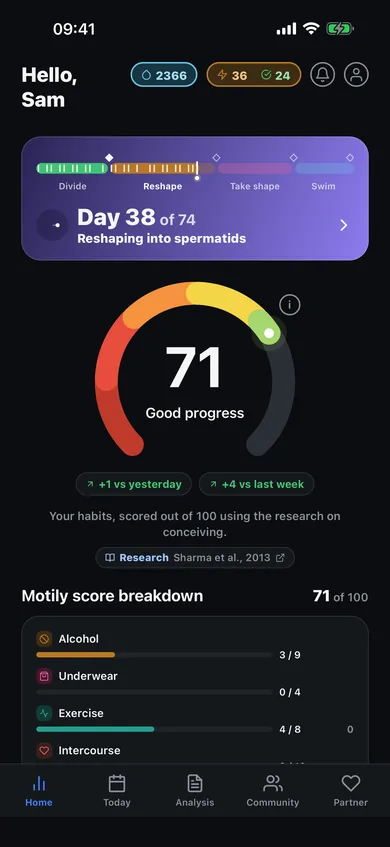
In Motily, the baseline is any semen analysis dated in the first 21 days of your 74-day journey (or up to 90 days before it), a reminder lands on day 74, the retest window runs to day 88, and the app then shows each parameter side by side with the change. Gains are green; dips are shown plainly, never in red. Motily does not test anything: you enter the numbers from whichever test you used, and it compares them against the WHO 6th edition limits. It is a lifestyle tool, not a medical device, and says so on the same screen.
What we left out, and why
Mojo (UK, mail-in AI analysis) still has a website, but the company behind it, Mojo Fertility Limited, is in liquidation at Companies House, with a winding-up resolution filed on 29 April 2026 and a voluntary liquidator appointed in May 2026. A UK reseller says it ceased trading in summer 2025. It is out. Hims does not sell a sperm test that we could find. Quest's at-home kit is a YO device sold by a retailer, so it is covered by the YO row. Bird&Be's lab kits (Comprehensive $249, Advanced $440) exist on its site but we could not confirm their parameters and lab, so only its home device is in the table. Anything we could not confirm from the maker's own site or a reputable review is out.
Questions people ask
Are at-home sperm tests accurate?
For what they measure, the makers of the FDA-cleared YO, Bird&Be and SpermCheck devices claim 97 to 98 percent agreement with lab methods, Labcorp says its rapid test matches a standard lab test, and the CE-marked ExSeed device claims above 95 percent. Mail-in kits (Fellow, Legacy, Malebox, Mate Health, Ro) are analyzed in accredited labs: a lab test with a postal step. The bigger limit is scope: home devices do not measure morphology, and any single sample varies a lot from the next.
What does a count-only sperm test miss?
Motility and morphology. A yes-or-no concentration test such as SpermCheck tells you whether there are at least 20 million sperm per milliliter, nothing about how many are swimming, swim forward, or are normally shaped. Concentration, motility and morphology each independently separate fertile from subfertile men in the research, so a normal count with poor motility can still be a problem, and a low count can come with excellent motility.
How far apart should I take a before-and-after sperm test?
About three months. Sperm take roughly 74 days to form plus one to two weeks to mature, so a sample taken in the two weeks after day 74 of a change is the first one made entirely under the new routine. Keep the abstinence period the same for both tests (two to seven days), use the same test or lab, and treat two points as a comparison rather than a trend. The FAQ has the timing studies.
Which home sperm test is available in the UK?
As of 29 September 2026: ExSeed (home device, UK and EU shipping), YO (ships internationally), and Malebox Health (mail-in lab analysis with a consultation, UK-wide). Legacy, Fellow, Mate Health, Ro and Labcorp OnDemand are US only. Mojo, a UK mail-in service, has stopped: the company behind it is in liquidation at Companies House. The NHS can also arrange a semen analysis through your GP.
Is a home test enough, or do I need a clinic?
A home test is a screen. If it is normal and you have been trying for under a year, it is reasonable to keep going. If it is low, if you have been trying for a year (six months if your partner is 35 or over), or if you have a known risk factor such as a varicocele, undescended testicle or past testosterone use, see a doctor and get a lab analysis, ideally two, a few weeks apart. Only a clinician can interpret the numbers in context.
Correction, 29 September 2026. This page said Fellow's full semen analysis was not yet available in New York, citing a July 2025 press release. Fellow announced in June 2026 that it is available to New York providers under a conditional state approval, with full approval still pending, and the row and the source now say that. Proov's row said $89.00 on sale from $99.99; its product page now lists a single price of $99.00, and the row says that. Malebox's options were also re-checked and updated, and Mojo's status is now taken from Companies House rather than a reseller's note.
Update, 4 October 2026. Added Mate Health, a US mail-in lab test, checked against its own site. The rows are now grouped by test type and alphabetical within each group, as the line above the table says; no other row changed.
Update, 8 October 2026. Added ratings and best-for picks. Every test is scored on the same three criteria, set out in the ratings section, using the facts in the table; Mate Health's and Legacy's figures were re-checked on their own sites the same day. We have agreed an affiliate deal with Mate Health; its link isn't live yet, and the rating doesn't depend on it.
Update, 5 October 2026. Motily joined ExSeed's affiliate programme, so the ExSeed link in the table now earns us a commission and is labeled as an affiliate link. ExSeed's row, its place under the grouping rule and its wording are unchanged; its prices and parameters were re-checked against its shop the same day.
Update, 6 October 2026. Added ExSeed's discount code MOTILY (10% off, not valid on subscriptions) beside its link. The code is an affiliate code, labeled as such. ExSeed's row, its place and its wording are unchanged.
Correction, 8 October 2026. Every kit was re-checked against its maker's site on 7 October 2026. Malebox does state an accredited partner lab. Labcorp's rapid test gives bands, not figures. Legacy's Basic kit has no morphology, so mail-in kits run from about one and a half times a home kit's price. The 2006 repeat-sample study measured count, motility and volume, not every standard parameter as we said.
Free on iPhone
Start your 74 days today.
Motily is on the App Store. Free to download, and every Premium feature is free for everyone during the launch period. Two minutes a day, and the 74-day journey starts on day one.