A semen analysis reports about eight numbers, and each is compared with a lower reference limit from the WHO laboratory manual, 6th edition (2021): volume 1.4 mL, concentration 16 million per mL, total count 39 million, total motility 42%, progressive motility 30%, normal morphology 4%, vitality 54%, and a pH of 7.2 or more. Those limits are the 5th centile of 3,589 men whose partners conceived within a year, so a value below one puts you in the bottom 5% of fertile men, not outside them. Results vary a lot between samples from the same man, which is why an abnormal result is repeated about three months later before anyone draws a conclusion.
The reference limits in one table
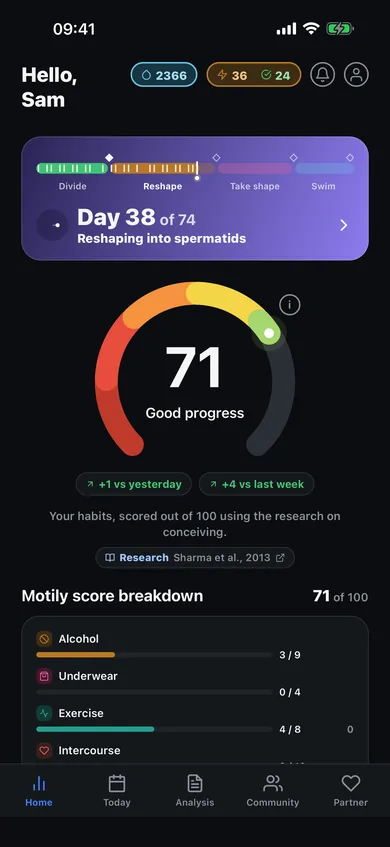
These are the same limits the Motily app uses, and the same ones behind the semen analysis checker. They come from Table 2.1 of the WHO manual, which reports one-sided lower limits (the 5th centile) for a reference population of fertile men.
| Measure | What it is | WHO 2021 lower reference limit |
|---|---|---|
| Semen volume | How much semen per ejaculation | 1.4 mL |
| Sperm concentration | Sperm per milliliter | 16 million/mL |
| Total sperm count | Concentration multiplied by volume | 39 million |
| Total motility | Share of sperm moving at all | 42% |
| Progressive motility | Share swimming forward | 30% |
| Morphology | Share with a typical shape (strict criteria) | 4% |
| Vitality | Share of sperm alive | 54% |
| pH | Acidity or alkalinity | 7.2 (consensus threshold, not a centile) |
If your report was produced before 2021, or by a lab that hasn't moved to the 6th edition, it may quote the 5th edition (2010) limits instead: 1.5 mL, 15 million/mL, 40% total motility, 32% progressive motility and 58% vitality. The differences are small and the reference population overlaps, so don't read anything into a value that sits between the two.
What "below reference" means
The WHO population was built from men whose partners became pregnant within 12 months, so every one of them was fertile by definition. The 5th centile is the value that 95% of those fertile men exceeded and 5% did not. A result below it means your sample looked like the bottom 5% of a fertile group, which is a reason to look closer, not a diagnosis. The manual itself is explicit that the limits are not a threshold between fertile and infertile, and the NICE guideline uses the WHO values as reference ranges rather than cut-offs. In the other direction, a result above every limit does not rule out a male factor either: sperm DNA integrity and function aren't captured by the standard test, and the other partner's fertility matters just as much.
The labels a lab may attach follow the same logic. Oligozoospermia means concentration or total count below the limit, asthenozoospermia means motility below it, teratozoospermia means morphology below it, and combinations get combined names. Azoospermia means no sperm were found at all, which is the one result that changes the next step immediately. The glossary has each of them.
Volume
Limit: 1.4 mL. Volume is how much fluid the sample contained, most of it from the seminal vesicles and prostate rather than the testes. A low volume is often a collection issue: part of the sample missed the pot, or the abstinence period was short. That's why it is the first number a lab asks about before reading anything into it. A persistently low volume with a low pH can point to a blockage or an absent duct, which is a question for a urologist. High volume is not a problem in itself.
Concentration
Limit: 16 million per mL. Concentration is how densely packed the sperm are. It is the number most men fixate on, and the one that varies most between samples: in a 2003 study that took repeated samples from 20 healthy men over ten weeks, concentration had the highest within-man variation of any measure, and two results from the same man had to differ by about 78% before the difference was more than noise. That is why a single concentration figure, high or low, deserves less weight than the trend across two or three tests.
Total sperm count
Limit: 39 million per ejaculate. Total count is concentration multiplied by volume, so a 3 mL sample at 20 million/mL is 60 million. It corrects for the fact that a small sample concentrates sperm and a large one dilutes them, which makes it a more stable single number than concentration. If your report gives only concentration and volume, multiply them; the checker tool does it for you.
Total and progressive motility
Limits: 42% total, 30% progressive. Motility is the share of sperm that are moving. Total motility counts everything that moves, including sperm twitching in place; progressive motility counts the ones swimming forward, which is the movement that matters for reaching an egg and the number most clinicians look at first. The two limits together tell you that in a fertile population most sperm still don't swim well. Some reports also give a total motile count (total count multiplied by total motility) or total progressively motile count, which fertility clinics use to plan treatment; there is no WHO reference limit for either, and our total motile sperm count calculator works it out from your own numbers. Motility falls quickly once a sample leaves the body, so a sample that took a while to reach the lab, or a mail-in test, will read lower than a fresh one. The motility guide covers what is linked to better motility.
Morphology
Limit: 4% normal forms. Morphology is the share of sperm with a typical shape under the strict criteria the WHO manual uses. The limit is low because, judged strictly, most sperm in every fertile man have a head, neck or tail that isn't textbook. Morphology is also the measure that depends most on who is looking down the microscope, so results vary between labs more than any other number on the page. A low morphology on its own, with everything else in range, is a common finding and rarely the reason a couple isn't conceiving. Treat it as the least reliable single number on the report. The morphology guide goes through what the number does and does not predict.
Vitality
Limit: 54% alive. Vitality is the share of sperm that are alive, whether or not they move. It matters mainly when motility is low, because it separates sperm that are alive but still (which can point to a tail problem or antibodies) from sperm that are dead. Many labs only report it when motility is below the limit.
pH
Threshold: 7.2 or more. Semen is slightly alkaline. The WHO gives 7.2 as a consensus threshold rather than a centile, which is why the app treats it differently from the other measures. A low pH together with a low volume and no sperm suggests the seminal vesicles are blocked or absent, and a high pH can accompany infection. On its own, in range, it rarely tells you anything.
Other things on the report
Liquefaction is how long the sample took to turn from a gel to a liquid, normally within 15 to 60 minutes; the lab notes it because a sample that doesn't liquefy is harder to count. Appearance and viscosity are lab observations. Round cells or leukocytes (white blood cells) may be reported; a high count can suggest inflammation and is a reason to ask about infection. Agglutination is sperm sticking to each other, which can hint at antisperm antibodies. DNA fragmentation is a separate test, not part of the standard analysis, that estimates how much of the sperm DNA is broken; there is no WHO reference limit, and labs use their own cut-offs, commonly treating under 20% as good and 30% or more as high. It isn't ordered routinely, and its place in the standard workup is still debated; the DNA fragmentation guide covers it.
What home tests report
Home tests fall into three groups. Threshold tests (for example SpermCheck) tell you whether concentration is above or below a fixed level, with no number. Smartphone or device tests (for example YO and ExSeed) estimate concentration and, in most cases, motility or motile sperm concentration, from a video of the sample. Mail-in lab tests (for example Legacy, Fellow and Mojo) send the sample to a laboratory that runs a fuller analysis, including morphology, with the caveat that motility drops in transit. A 2020 review in the World Journal of Men's Health concluded that home devices can't be regarded as a replacement for a standard semen analysis, mainly because they don't assess morphology and the other measures above, and the Mayo Clinic makes the same point. What a home test is good for is a first look, and a private one: if it shows sperm and a concentration near or above the limit, that's reassuring; if it shows a low result, it is a reason to get a laboratory test, not a diagnosis.
Why one result is not a verdict
Three things make a single semen analysis a noisy measurement. First, biological variation: the 2003 study above found concentration varied so much within healthy men that the authors concluded conventional reference values have "little diagnostic value because of their marked individuality", while serial measurements in the same man remain useful. Second, the abstinence window: the WHO manual asks for 2 to 7 days without ejaculation before the sample, because a shorter gap lowers volume and count and a longer one lowers motility. A sample collected after one day or after two weeks is being compared with the wrong reference. Third, timing against the production cycle: sperm take about 74 days to develop, so a sample reflects the previous two to three months, including any illness, fever, heavy drinking or heat exposure in that window. A high fever eight weeks ago can show up as a low result today.
This is why the guidance everywhere is to repeat before acting. NICE has clinics repeat an abnormal result about three months later; the AUA and ASRM guideline says "at least two semen analyses obtained a month apart are important to consider, especially if the first has abnormal parameters", and explains that semen parameters "are highly variable biological measures and may vary substantially from test to test".
Retesting
If your first result is below a limit, the retest is the next step, not treatment. NICE's timing is three months, to let a full cycle of sperm production complete, with one exception: if no sperm were found (azoospermia) or the count was very low, the repeat is done as soon as possible because the next steps are different and shouldn't wait. Keep the conditions the same between tests: the same lab where you can, the same abstinence window, and a note of anything unusual in the three months before each one. If you have changed a habit since the first test, the retest is also the first sample that can show it, and the 74-day timeline tool will give you the date. Comparing two results is where the trend starts to mean something; the Motily app tracks each value across reports for exactly that reason. The retest guide covers the timing and how to keep two tests comparable.
When to see a urologist or andrologist
A GP or fertility clinic can order and read a semen analysis. A urologist or andrologist (a doctor specializing in male reproductive health) is the referral when the result points to something structural or hormonal rather than lifestyle. The AUA and ASRM guideline recommends assessing both partners at the same time from the start, and specifically that men with an abnormal semen analysis, or with a history that raises a flag, are seen by a male reproductive expert. Results that should prompt that referral rather than a wait-and-see retest: no sperm found; a very low count; a low volume with a low pH; a high white cell count; or any abnormal result alongside a varicocele, a history of undescended testicle, mumps after puberty, groin or testicular surgery, chemotherapy or radiotherapy, or past testosterone or anabolic steroid use. A specialist will typically examine you, check hormones (FSH, LH, testosterone) and sometimes scan the testes, and can tell you whether the finding is something to treat, something to work around, or something lifestyle can move.
What to do
- Run your numbers through the checker to see each one against the WHO 2021 limit, and calculate total count if the report doesn't give it.
- Check the abstinence window and collection notes on the report before reading anything into a low volume or count.
- Think back over the three months before the sample: fever, illness, heavy drinking, hot tubs, a new medication. Any of these can explain one low result.
- If any value is below the limit, book the repeat test for about three months later, same lab and same abstinence window, unless no sperm were found, in which case ask for the repeat straight away.
- Use those three months on the changes with the best evidence, in the increase sperm count guide.
- Ask for a referral to a urologist or andrologist if the result is severe, structural, or comes with a history that raises a flag, and make sure your partner is being assessed in parallel.
Common questions
What is a normal sperm count?
The WHO 2021 lower reference limits are 16 million per mL for concentration and 39 million per ejaculate for total count. Those are the 5th centile of fertile men, so most fertile men are well above them; "normal" is a range, not a single number, and values below the limit don't mean infertile.
Is 4% morphology bad?
4% is the WHO lower reference limit under strict criteria, so 4% is at the limit, not below it. Morphology is the most variable measure between labs and, on its own with everything else in range, rarely the reason a couple isn't conceiving.
How long should I abstain before a semen analysis?
The WHO manual asks for 2 to 7 days. Shorter lowers volume and count; longer lowers motility. Use the same window for every test so the results can be compared.
Can a semen analysis be wrong?
It can be unrepresentative. Concentration in particular varies a lot between samples from the same man, and collection problems, a short abstinence window, or a fever in the previous three months can all pull one result down. That's why guidelines repeat an abnormal test before acting on it.
Sources
- World Health Organization. WHO laboratory manual for the examination and processing of human semen, 6th edition. Geneva, 2021.
- Boitrelle F, et al. The sixth edition of the WHO manual for human semen analysis: a critical review and SWOT analysis. Life, 2021. (Reference population: 3,589 fertile men from 12 countries.)
- Chung E, et al. Sixth edition of the World Health Organization laboratory manual of semen analysis: updates and essential take away for busy clinicians. Arab Journal of Urology, 2023. (Abstinence of 2 to 7 days.)
- NICE. Fertility problems: assessment and treatment (NG257). 2026.
- American Urological Association and ASRM. Diagnosis and treatment of infertility in men: AUA/ASRM guideline. 2020, amended 2024.
- Alvarez C, et al. Biological variation of seminal parameters in healthy subjects. Human Reproduction, 2003.
- Gonzalez D, et al. Clinical update on home testing for male fertility. World Journal of Men's Health, 2020.
- Mayo Clinic. Is a home sperm test useful?
- Heller CG, Clermont Y. Kinetics of the germinal epithelium in man. Recent Progress in Hormone Research, 1964.
- NHS. Infertility.
Correction, 8 October 2026. The WHO 2021 reference population came from 12 countries, not 13.