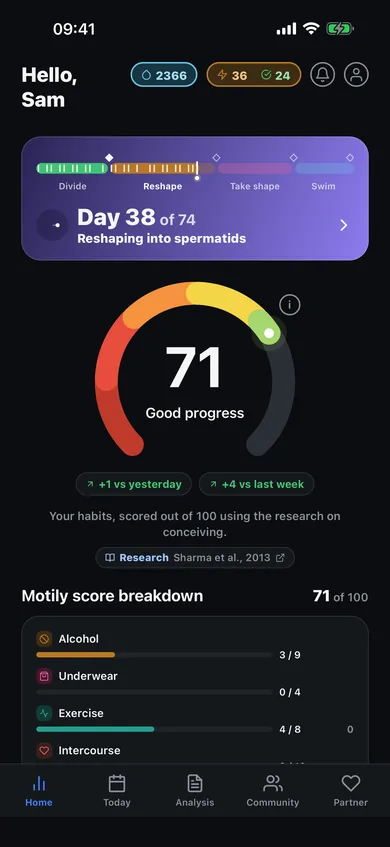
Sperm are replaced on a cycle of roughly 74 days, so most changes take two to three months to show in a semen analysis. The factors with the strongest evidence are smoking (a 2016 meta-analysis of 5,865 men found smokers had lower count, motility and morphology), body weight (morbidly obese men had twice the odds of a low count in a meta-analysis of 13,077 men) and heat around the testicles, which is reversible within months. Sleep, heavy drinking and diet come next; supplements come last, because the 2022 Cochrane review calls the evidence inconclusive.
The summary table
Strength of evidence is a judgment about the studies, not the size of the effect: "strong" means several large studies or a meta-analysis point the same way, "moderate" means good studies with some inconsistency, "mixed" means the studies disagree, and "weak" means small or single studies. Timeframes are tied to the sperm production cycle explained below.
| Factor | Evidence | Typical timeframe | Action |
|---|---|---|---|
| Smoking | Strong | 2 to 3 months after quitting | Stop completely; there is no dose the evidence calls safe |
| Weight | Strong | 3 months or more, and only if kept off | Gradual loss toward a healthy BMI if you are obese |
| Heat | Strong | 3 to 6 months after the exposure stops | No hot tubs or saunas, laptop off your lap, looser underwear |
| Alcohol | Moderate | 2 to 3 months | Keep it occasional; daily and heavy drinking are what the studies flag |
| Sleep | Moderate | 2 to 3 months | 7 to 8 hours, consistent times |
| Diet | Moderate | 3 months or more, cumulative | More whole food, fish, vegetables, nuts; less processed meat and sugary drinks |
| Exercise | Moderate | 2 to 3 months | Regular moderate activity; avoid very long weekly hours in the saddle |
| Stress | Mixed | 2 to 3 months | Treat it as a trend; small daily habits |
| Caffeine | Mixed | Not established | Coffee and tea look fine in normal amounts; cut sugary caffeinated soft drinks |
| Supplements | Weak | 3 months in the trials that exist | Food first; ask a clinician before adding anything |
| Ejaculation frequency | Moderate | Days | Don't save up; every 1 to 2 days in the fertile window |
| Age | Strong | Not modifiable | Start the other changes earlier rather than later |
Why every change takes two to three months
Sperm are made continuously in the testes, and one cell takes about 74 days to go from stem cell to sperm. That number comes from Heller and Clermont's 1964 tracer study, which is why Motily's journey runs for 74 days. A 2006 study using a stable-isotope label found new sperm reached the ejaculate after an average of 64 days, including the one to two weeks sperm spend passing through the epididymis after leaving the testis, with real variation between men. So the ejaculate on any day is a mix of cells that started developing across the previous two to three months.
Two things follow. A habit you change today protects the cells that are at a sensitive stage now, and those cells won't be in a sample for weeks. And a semen analysis taken two weeks into a new routine mostly reflects the old routine, which is why the UK's NICE guideline has clinics repeat an abnormal test about three months later, "to allow time for the cycle of spermatozoa formation to be completed". The how-long guide goes into the timing in more detail, and the 74-day timeline tool turns it into dates.
Smoking and vaping
What the evidence says. Smoking is the most consistently confirmed lifestyle factor. A 2016 meta-analysis of 20 studies and 5,865 men found smokers had lower sperm count, lower motility and poorer morphology than non-smokers, with larger effects in moderate and heavy smokers. A 2019 meta-analysis limited to men attending fertility clinics (16 studies, 10,823 men) found smokers were 1.29 times as likely to have a low sperm count (oligozoospermia) and had more head, neck and tail defects. The morphology guide explains how much sperm shape actually predicts. Vaping is much less studied: in one 2020 study, of 1,221 young Danish men asked about e-cigarettes, the 25 who vaped daily had an adjusted total sperm count of 91 million against 147 million in non-users. That is a single observational finding and needs replication, but it is not reassuring. Cannabis is a murkier picture, covered in the cannabis guide.
How long until it shows. The studies compare smokers with non-smokers rather than following men after quitting, so the recovery time is an inference from the production cycle: cells that develop entirely after you stop are the ones a test two to three months later measures.
What to do this week. Stop, rather than cut down: the meta-analyses found a dose effect but no threshold below which nothing happened. If you switched from cigarettes to vaping, the thin evidence so far points the same way. Free stop-smoking support in the UK is on the NHS Better Health site. Full detail in the smoking and vaping guide.
Weight
What the evidence says. Body weight is linked to sperm count in a J-shaped curve. A 2013 collaborative meta-analysis of 21 studies and 13,077 men found that, compared with men of normal BMI, overweight men had 1.11 times the odds of a low or absent sperm count, obese men 1.28 times, and men with a BMI of 40 or over 2.04 times; underweight men showed a small rise that was not statistically significant. The proposed mechanisms are lower testosterone, higher estrogen from fat tissue, and warmer testicles.
Weight loss appears to reverse some of this. In a 2022 Danish trial, 56 men with obesity (average BMI 37) followed an 800-calorie-a-day diet for eight weeks and took off an average of 16.5 kg; in the 47 who gave a sample afterward, sperm concentration rose 1.49-fold and total count 1.41-fold, with no change in motility. Over the following year the gains held only in men who kept most of the weight off, and disappeared in men who regained it.
How long until it shows. The Danish trial saw the change after eight weeks of dieting, and it depended on maintaining the loss. Count this as a three-month-plus change, and one that only counts if it lasts.
What to do this week. If your BMI is 30 or over, gradual loss toward a healthy range is one of the better-supported things you can do. Crash diets aren't the recommendation; the trial used one under medical supervision, and the year-long follow-up is the point. If your BMI is in the normal range, this factor isn't yours to work on. The weight guide has the trial and the BMI bands in detail.
Heat
What the evidence says. The testes sit outside the body because sperm production works best a couple of degrees below core temperature, and raising scrotal temperature is linked to lower sperm production in study after study. In a small 2013 study, ten healthy men who used a sauna for 15 minutes at 80 to 90°C twice a week for three months showed a marked fall in sperm count and motility, and every measure was back to baseline by the six-month follow-up. In a 2007 pilot study of 11 infertile men who used hot tubs or hot baths for 30 minutes or more a week, five improved after stopping for three to six months, with motility rising from an average of 12% to 34%. A 2005 study of 29 men found a working laptop on the lap raised scrotal temperature by 2.6 to 2.8°C, against 2.1°C from the same seated position without one. On clothing, a 2018 study of 656 men attending a fertility center found men who mostly wore boxers had 25% higher sperm concentration and 17% higher total count than men who wore tighter styles.
How long until it shows. Three to six months in the sauna and hot tub studies, which makes heat one of the fastest reversible factors on this list.
What to do this week. Skip saunas and hot tubs while trying to conceive, use a desk or lap tray for the laptop, choose looser, breathable underwear, and break up long stretches of sitting. Detail on each exposure, including cycling, is in the heat guide; phones and Wi-Fi are a separate question, in the phones and laptops guide.
Alcohol
What the evidence says. The pattern matters more than the fact of drinking. A 2017 systematic review and meta-analysis of 15 studies covering more than 16,000 men found daily alcohol intake was associated with lower semen volume and poorer morphology, while occasional drinking wasn't consistently linked to any measure. A 2014 cross-sectional study of 1,221 young Danish men found effects from about 5 units a week upward, most apparent above 25 units a week; men drinking more than 40 units a week had a sperm concentration 33% lower than men drinking 1 to 5 units, with lower total count and fewer normal-looking sperm as well. Heavy drinking is also linked to lower testosterone.
How long until it shows. Two to three months, on the production cycle, with no direct study of recovery time.
What to do this week. Make most days alcohol-free and keep the rest moderate. If you drink daily, that is the habit to change first. The alcohol guide covers units and the studies in detail.
Sleep
What the evidence says. Sleep is linked to sperm count in both directions. In a cross-sectional study of 953 healthy young Danish men, those with the most sleep disturbance had sperm concentrations around 29% lower, and slightly fewer normally shaped sperm, than men with little disturbance. A longitudinal study of Chinese university students found an inverse U shape: compared with 7 to 7.5 hours, men sleeping over 9 hours had around 39% lower sperm number, and men sleeping 6.5 hours or less around 26% lower, a difference that fell just short of statistical significance. Both are observational, so they show association rather than cause, but the direction is consistent.
How long until it shows. Two to three months. The Chinese study followed men over time, which helps, but nobody has run a trial that fixes sleep and measures sperm afterward.
What to do this week. Aim for 7 to 8 hours at consistent bed and wake times. If your sleep is short because of shift work or a baby, the target is consistency where you can get it, not perfection. More in the sleep guide.
Diet
What the evidence says. Dietary pattern is the strongest nutritional signal. A 2017 systematic review of observational studies found diets rich in vegetables, fruit, fish, seafood, poultry, whole grains, nuts and low-fat dairy were associated with better semen quality, while diets high in processed meat, full-fat dairy, sweets, sugary drinks and alcohol were associated with worse. A 2020 study of 2,935 young Danish men put a number on it: men in the highest fifth for a "prudent" pattern (fish, chicken, vegetables, fruit, water) had total sperm counts 43 million higher than men in the lowest fifth, and men in the highest fifth for a Western pattern (pizza, chips, processed and red meat, snacks, sugary drinks) had counts 26 million lower.
How long until it shows. Three months or more, and cumulative: diet works on the building blocks the first weeks of the cycle draw on, so it is a slow lever rather than a fast one.
What to do this week. Push the share of whole, unprocessed food up and the sugary drinks down. Oily fish, vegetables, fruit, nuts and legumes are the foods that come up repeatedly. You don't need a named diet; the diet guide lists the foods and the one trial.
Exercise
What the evidence says. Moderate, regular activity is linked to better semen quality, and extremes in either direction to worse. A 2019 systematic review and meta-analysis of 32 studies found most showed no major effect of physical activity on semen quality, though recreational activity was linked to better concentration or progressive motility and elite-level training to poorer motility. Very high training loads are the exception, and cycling is the specific case with data: in a 2011 study of 2,261 men attending a fertility clinic, bicycling five or more hours a week was associated with roughly double the odds of low sperm concentration and low total motile count, while regular exercise in general was not associated with any semen measure.
How long until it shows. Two to three months, on the production cycle.
What to do this week. If you are sedentary, a daily walk is a legitimate start; 25 to 45 minutes of moderate activity a day is the band Motily scores best. If you ride a lot, the fix is fewer hours in the saddle rather than no exercise. The exercise guide goes through the studies.
Stress
What the evidence says. Mixed, and honest copy should say so. A 2014 study of 193 men found those reporting two or more stressful life events in the past year had lower motility and a lower share of normal-shaped sperm, and job strain was linked to lower testosterone. A 2016 study of 1,215 Danish men found self-rated stress was associated with lower semen quality mainly at the highest stress levels, with no clear effect at moderate levels. The proposed mechanism runs through cortisol suppressing testosterone.
How long until it shows. Two to three months, if it shows at all; the effect in the studies is at the severe end.
What to do this week. Treat stress as a trend, not a daily score, and pick one small repeatable thing: a walk, a few minutes of breathing, an earlier night. Exercise and sleep both feed into this, and the stress guide looks at what the studies can and can't say.
Caffeine
What the evidence says. Coffee and tea in ordinary amounts don't appear to affect semen quality. A 2017 systematic review of 28 observational studies covering nearly 20,000 men found semen quality didn't seem affected by caffeine from coffee, tea or cocoa in most studies, though cola and other caffeinated soft drinks were linked to lower volume, count and concentration. The soft-drink finding is hard to separate from sugar and overall diet, and the authors called the evidence inconsistent.
What to do this week. Two or three cups of coffee a day aren't the problem. Sugary caffeinated soft drinks are the thing to cut, and that belongs to the diet section as much as this one. The caffeine guide has the numbers.
Supplements
What the evidence says. This is where the marketing is loudest and the evidence weakest. The 2022 Cochrane review of antioxidants for male subfertility found very low-certainty evidence that antioxidants may improve live birth rates (12 trials, 1,283 men), and when the trials at high risk of bias were removed the benefit disappeared. Clinical pregnancy rates may increase (low certainty, based on 327 pregnancies in small studies), and antioxidants may cause mild stomach upset. The authors' conclusion: "current evidence is inconclusive", and large, well-designed trials are needed. The two largest recent trials point the same way. MOXI (2020) gave 174 men with male-factor infertility a combined antioxidant (vitamins C and E, selenium, L-carnitine, zinc, folic acid, lycopene) for three to six months and found no improvement in concentration, motility, morphology or DNA fragmentation, and no difference in live birth. FAZST (2020) gave 2,370 men 5 mg folic acid and 30 mg zinc a day for six months and found no improvement in semen quality or live birth, with slightly higher DNA fragmentation and more stomach complaints in the supplement group.
By ingredient, briefly. CoQ10: a 2013 meta-analysis of three small trials (149 men on CoQ10, 147 on placebo) found concentration about 5 million/mL higher and motility about 4.5 percentage points higher, with no increase in pregnancy rate and no live birth data. Zinc: a 2016 meta-analysis of 20 mostly small studies found infertile men had lower seminal zinc and that supplementation was linked to better volume, motility and morphology, but the large FAZST trial found no benefit from zinc plus folate. Folate: FAZST, as above. Vitamin D: a 2018 Danish trial of 330 infertile men found high-dose vitamin D didn't change semen parameters or overall live birth; a secondary analysis in men with low counts showed a higher live birth rate (35.6% against 18.3%), which the authors flagged as needing its own trial. Omega-3: a 2020 cross-sectional study of 1,679 young Danish men found fish oil users had higher semen volume and total count and larger testes than non-users, but as an observational study it can't separate the supplement from the kind of man who takes it. The complete rundown is in the supplements guide.
What to do this week. Get the nutrients from food, which the diet studies support. If you take a supplement anyway, choose one product, tell your doctor, and don't expect a test to move because of it.
Ejaculation frequency
What the evidence says. The old advice to save up has been overtaken. The American Society for Reproductive Medicine's committee opinion on optimizing natural fertility says the chance of pregnancy is highest with intercourse every one to two days during the fertile window, and that two to three times a week does nearly as well. A 2016 study that had 20 men ejaculate daily for two weeks found volume, concentration and total motile count fell, mostly in the first three days before leveling off, while motility and morphology were unchanged. Several studies link shorter abstinence to lower sperm DNA fragmentation.
How long until it shows. Days. This is the one factor on the page that changes a sample within a week rather than a cycle, which is why labs ask for a set abstinence window (2 to 7 days in the WHO manual) before a test.
What to do this week. Don't ration it. Every one to two days across the fertile window is the guidance; the frequency guide explains why.
Age
What the evidence says. A 2015 systematic review and meta-analysis of 90 studies and about 94,000 men found consistent age-related declines in semen volume, motility and normal morphology, and an increase in DNA-fragmented sperm; it did not estimate the age at which the declines begin. Sperm concentration did not decline consistently with age in that analysis.
What to do this week. You can't change it, so use it as the reason to start the changeable factors now rather than after the next test. The age guide covers what changes and from when.
When to see a doctor
The NHS advises seeing a GP if you haven't conceived after a year of regular unprotected sex, and sooner if your partner is 36 or over or either of you already knows of a fertility problem. The American Urological Association and ASRM guideline uses 12 months when the woman is under 35 and 6 months when she is 35 or older, and recommends that both partners are assessed at the same time rather than the man waiting his turn. Go sooner if you have a varicocele, a history of undescended testicle, mumps after puberty, groin or testicular surgery, chemotherapy or radiotherapy, or past testosterone or anabolic steroid use (the testosterone guide explains why). A semen analysis is a normal first step, not a last resort; the UK sperm test guide covers how to get one, and the results guide explains what comes back.
What to do this week
- If you smoke or vape, stop. It is the single best-supported change on this page.
- Take the heat out: no hot tubs or saunas, laptop on a desk, looser underwear, fewer hours sitting or cycling.
- Make most days alcohol-free; if you drink daily, change that first.
- Set a bedtime that gives you 7 to 8 hours and keep it on weekends.
- Shift the plate toward whole food: fish, vegetables, fruit, nuts, legumes; cut sugary drinks.
- Move for 25 to 45 minutes most days.
- If your BMI is 30 or over, start a gradual, sustainable loss.
- Skip the supplement aisle unless a clinician suggests something specific.
- Book a semen analysis now, and put the retest in the calendar for three months after any change you make.
Common questions
What increases sperm count the fastest?
Removing an acute insult. Heat exposure is the factor where studies show recovery within months once the exposure stops, and ejaculation timing changes a sample within days; for heavy drinking the two-to-three-month estimate comes from the production cycle rather than a recovery study. Diet and weight are slower and cumulative. Nothing changes a semen analysis overnight, because the sperm in any sample started developing two to three months earlier.
Can sperm count be increased naturally?
The evidence says lifestyle factors are linked to count, and for weight and heat there are studies showing counts rising after the change. Whether that is enough for any one couple depends on why the count is low, which is a question for a semen analysis and a doctor, not a guide.
How long does it take to increase sperm count?
About two to three months for most changes, because one cycle of sperm production takes roughly 74 days plus one to two weeks of maturing in the epididymis. Clinics repeat an abnormal test about three months later for this reason.
Do supplements increase sperm count?
The 2022 Cochrane review calls the evidence inconclusive, and the two largest recent trials (MOXI and FAZST) found no benefit for semen quality or live birth. Some small trials of CoQ10 and zinc show higher concentration or motility, without evidence that pregnancies follow. Food first.
Sources
- Heller CG, Clermont Y. Kinetics of the germinal epithelium in man. Recent Progress in Hormone Research, 1964.
- Misell LM, et al. A stable isotope-mass spectrometric method for measuring human spermatogenesis kinetics in vivo. Journal of Urology, 2006.
- NICE. Fertility problems: assessment and treatment (NG257). 2026.
- Sharma R, et al. Cigarette smoking and semen quality: a new meta-analysis. European Urology, 2016.
- Bundhun PK, et al. Tobacco smoking and semen quality in infertile males: a systematic review and meta-analysis. BMC Public Health, 2019.
- Holmboe SA, et al. Use of e-cigarettes associated with lower sperm counts in a cross-sectional study of young men from the general population. Human Reproduction, 2020.
- Sermondade N, et al. BMI in relation to sperm count: an updated systematic review and collaborative meta-analysis. Human Reproduction Update, 2013.
- Andersen E, et al. Sperm count is increased by diet-induced weight loss and maintained by exercise or GLP-1 analogue treatment: a randomized controlled trial. Human Reproduction, 2022.
- Garolla A, et al. Seminal and molecular evidence that sauna exposure affects human spermatogenesis. Human Reproduction, 2013.
- Shefi S, et al. Wet heat exposure: a potentially reversible cause of low semen quality in infertile men. International Braz J Urol, 2007.
- Sheynkin Y, et al. Increase in scrotal temperature in laptop computer users. Human Reproduction, 2005.
- Mínguez-Alarcón L, et al. Type of underwear worn and markers of testicular function among men attending a fertility center. Human Reproduction, 2018.
- Ricci E, et al. Semen quality and alcohol intake: a systematic review and meta-analysis. Reproductive BioMedicine Online, 2017.
- Jensen TK, et al. Habitual alcohol consumption associated with reduced semen quality and changes in reproductive hormones; a cross-sectional study among 1221 young Danish men. BMJ Open, 2014.
- Jensen TK, et al. Association of sleep disturbances with reduced semen quality. American Journal of Epidemiology, 2013.
- Chen Q, et al. Inverse U-shaped association between sleep duration and semen quality. Sleep, 2016.
- Salas-Huetos A, et al. Dietary patterns, foods and nutrients in male fertility parameters and fecundability. Human Reproduction Update, 2017.
- Nassan FL, et al. Association of dietary patterns with testicular function in young Danish men. JAMA Network Open, 2020.
- Ibañez-Perez J, et al. An update on the implication of physical activity on semen quality: a systematic review and meta-analysis. Archives of Gynecology and Obstetrics, 2019.
- Wise LA, et al. Physical activity and semen quality among men attending an infertility clinic. Fertility and Sterility, 2011.
- Janevic T, et al. Effects of work and life stress on semen quality. Fertility and Sterility, 2014.
- Nordkap L, et al. Psychological stress and testicular function: a cross-sectional study of 1,215 Danish men. Fertility and Sterility, 2016.
- Ricci E, et al. Coffee and caffeine intake and male infertility: a systematic review. Nutrition Journal, 2017.
- de Ligny W, et al. Antioxidants for male subfertility. Cochrane Database of Systematic Reviews, 2022.
- Steiner AZ, et al. The effect of antioxidants on male factor infertility: the MOXI randomized clinical trial. Fertility and Sterility, 2020.
- Schisterman EF, et al. Effect of folic acid and zinc supplementation in men on semen quality and live birth: the FAZST randomized clinical trial. JAMA, 2020 (NICHD summary).
- Lafuente R, et al. Coenzyme Q10 and male infertility: a meta-analysis. Journal of Assisted Reproduction and Genetics, 2013.
- Zhao J, et al. Zinc levels in seminal plasma and their correlation with male infertility: a systematic review and meta-analysis. Scientific Reports, 2016.
- Blomberg Jensen M, et al. Effects of vitamin D supplementation on semen quality, reproductive hormones, and live birth rate: a randomized clinical trial. Journal of Clinical Endocrinology and Metabolism, 2018.
- Jensen TK, et al. Associations of fish oil supplement use with testicular function in young men. JAMA Network Open, 2020.
- Practice Committee of the American Society for Reproductive Medicine. Optimizing natural fertility: a committee opinion. Fertility and Sterility, 2022.
- Welliver C, et al. Analysis of semen parameters during 2 weeks of daily ejaculation. Translational Andrology and Urology, 2016.
- Johnson SL, et al. Consistent age-dependent declines in human semen quality: a systematic review and meta-analysis. Ageing Research Reviews, 2015.
- NHS. Infertility.
- American Urological Association and ASRM. Diagnosis and treatment of infertility in men: AUA/ASRM guideline. 2020, amended 2024.
- World Health Organization. WHO laboratory manual for the examination and processing of human semen, 6th edition. 2021.
Correction, 11 September 2026. This page previously attributed the 74-day figure to Heller and Clermont's 1963 paper. That paper estimated about 64 days; the 74-day figure comes from their 1964 paper, which is now the cited source. The figure itself is unchanged.
Correction, 8 October 2026. Corrected the vaping study size and figures, the 2022 weight-loss trial size (56 men started, 47 gave a sample afterward), the alcohol figures (33% lower concentration above 40 units a week; no 51% figure), the short-sleep result (not statistically clear), the 2019 exercise review, the ASRM timing advice, the ages attributed to the 2015 age meta-analysis, and a line that credited heavy drinking with recovery data.