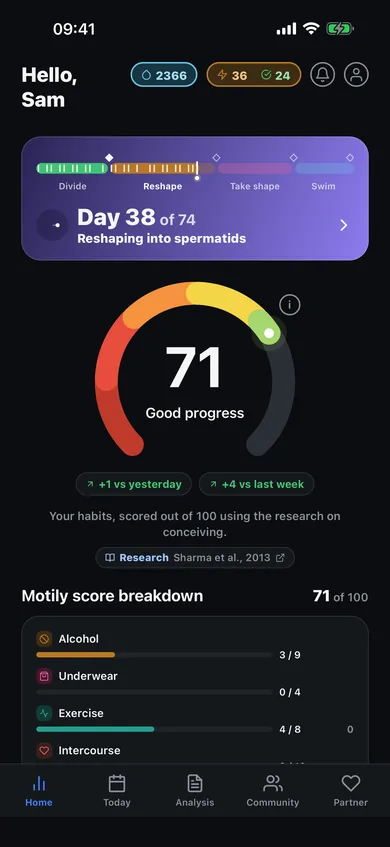
Most of these terms describe one of three things: a stage of the roughly 74-day process that makes sperm, a number on a semen analysis and its WHO 2021 lower reference limit (for example concentration 16 million/mL, total motility 42%, normal morphology 4%), or a fertility treatment. Where a term has a limit, remember that below the limit means below the 5th centile of fertile men, not infertile.
- Abstinence period
- The number of days without ejaculation before a semen sample is collected. The WHO manual asks for 2 to 7 days, because a shorter gap lowers volume and count and a longer one lowers motility; use the same window for every test so results can be compared.
- Andrologist
- A doctor or scientist specializing in male reproductive health, including sperm production, hormones and the testes. In the UK the specialist you are referred to is usually a urologist with an andrology interest; in some countries andrology is its own specialty.
- Antioxidants
- Substances (vitamins C and E, CoQ10, selenium, zinc, L-carnitine, lycopene among them) that neutralize the reactive molecules behind oxidative stress. They come from food and are sold as fertility supplements; the 2022 Cochrane review calls the trial evidence for supplements inconclusive, as the supplements guide explains.
- Antisperm antibodies
- Antibodies the immune system makes against a man's own sperm, which can make sperm clump together or swim poorly. They are tested for when other results don't explain a fertility problem, often after a vasectomy reversal or testicular injury; there is no WHO reference limit, and labs report a percentage of sperm with antibodies bound.
- Asthenozoospermia
- A semen analysis in which the share of moving sperm is below the reference limit (WHO 2021: 42% total motility, 30% progressive motility). It describes one sample, not a permanent state, and is often combined with other terms, as in oligoasthenozoospermia.
- Azoospermia
- No sperm found in the ejaculate, even after the sample is spun down and re-examined. It can be obstructive (sperm are made but blocked) or non-obstructive (few or none are made), and it is the one result guidelines say should be repeated as soon as possible and referred to a specialist rather than waited on.
- BMI
- Body mass index: weight in kilograms divided by height in meters squared. A 2013 meta-analysis of 13,077 men found obese men had 1.28 times, and men with a BMI of 40 or over about twice, the odds of a low or absent sperm count compared with men of normal BMI, which is why Motily's onboarding asks for height and weight.
- DNA fragmentation
- Breaks in the DNA carried by sperm, reported as a DNA fragmentation index (DFI), the percentage of sperm with damaged DNA. It is a separate test from the standard semen analysis, has no WHO reference limit, and labs commonly treat under 20% as good and 30% or more as high; its place in routine testing is still debated. See the DNA fragmentation guide.
- Epididymis
- The long, tightly coiled tube on the back of each testis where newly made sperm spend their final one to two weeks, gaining the ability to swim and to fertilize an egg. Motily calls this phase "learning to swim".
- Fertile window
- The roughly six days in a menstrual cycle when intercourse can lead to pregnancy: the five days before ovulation and the day of ovulation itself. ASRM's guidance supports intercourse every one to two days across this window rather than saving up.
- FSH
- Follicle-stimulating hormone, released by the pituitary gland to drive sperm production in the testes. A high FSH on a blood test can mean the testes are working harder than normal to make sperm, which is why it is one of the first hormones a specialist checks.
- ICSI
- Intracytoplasmic sperm injection: a form of IVF in which a single sperm is injected directly into an egg in the laboratory. It is the usual treatment when sperm count, motility or morphology is very low, because it needs only a handful of sperm.
- IUI
- Intrauterine insemination: prepared sperm are placed directly into the uterus around ovulation, so they start closer to the egg. It is a simpler treatment than IVF and is generally used when semen quality is near normal.
- IVF
- In vitro fertilization: eggs are collected and fertilized with sperm in a laboratory, and an embryo is placed in the uterus. The NHS has a plain explanation of IVF.
- Leydig cells
- Cells in the testes, between the sperm-producing tubules, that make testosterone in response to the pituitary hormone LH. Sperm production depends on the high local testosterone they provide.
- Liquefaction
- The change of freshly ejaculated semen from a gel to a liquid, which normally happens within about 15 to 60 minutes at room temperature. The lab notes it because a sample that doesn't liquefy is harder to count accurately.
- Morphology
- The share of sperm with a typical shape (head, midpiece and tail) under the strict criteria the WHO manual uses. The 2021 lower reference limit is 4%, because most sperm in every fertile man look atypical by those criteria, and it is the measure that varies most between labs.
- Motility
- The share of sperm that are moving. Total motility counts any movement, including sperm twitching in place, and its WHO 2021 lower reference limit is 42%; see also progressive motility.
- Normozoospermia
- A semen analysis in which every measured value is at or above its reference limit. It means the sample looked like the fertile reference population; it doesn't rule out a male factor, because DNA integrity and function aren't part of the standard test.
- Oligozoospermia
- A sperm concentration or total count below the reference limit (WHO 2021: 16 million/mL or 39 million per ejaculate). Concentration varies a lot between samples from the same man, so the term is confirmed on a repeat test before anything is read into it.
- Oxidative stress
- An excess of reactive oxygen molecules over the body's capacity to neutralize them, which can damage cell membranes and DNA. Smoking, heavy drinking, obesity and heat all raise it, and the developing sperm cell is thought to be most exposed while its DNA is being reorganized in the middle of the cycle.
- pH
- How acidic or alkaline semen is; it is normally slightly alkaline, and the WHO manual gives 7.2 as a consensus threshold rather than a centile. A low pH together with low volume can point to a blockage or absent seminal vesicles.
- Progressive motility
- The share of sperm swimming forward rather than moving in place, with a WHO 2021 lower reference limit of 30%. It is the kind of movement that matters for reaching an egg and the motility number clinicians look at first.
- Retest
- A repeat semen analysis after an abnormal result. NICE recommends it about three months later so a full cycle of sperm production has completed, and the AUA/ASRM guideline suggests two analyses a month apart; both treat one result as too variable to act on alone.
- Scrotal temperature
- The temperature of the testes, which sit outside the body because sperm production works best a couple of degrees below core temperature. Saunas, hot tubs, a laptop on the lap and tight clothing all raise it, and the heat guide covers the studies.
- Semen analysis
- The laboratory test of a semen sample that reports volume, concentration, total count, motility, morphology and usually pH and vitality. It is the first test for the male partner in a fertility workup, and the results guide explains each number.
- Sertoli cells
- The "nurse" cells inside the sperm-producing tubules of the testes, which support and feed developing sperm cells through every stage of spermatogenesis.
- Sperm concentration vs total count
- Concentration is sperm per milliliter (WHO 2021 limit 16 million/mL); total count is concentration multiplied by volume, the number of sperm in the whole sample (limit 39 million). Total count is the more stable single number, because a small sample concentrates sperm and a large one dilutes them.
- Spermatogenesis
- The whole process of making sperm in the testes, from stem-cell division through meiosis to a finished sperm cell, which takes roughly 74 days in men. It runs continuously, so the ejaculate on any day is a mix of sperm that started developing across the previous two to three months.
- Spermatogonia
- The stem cells lining the tubules of the testes that divide to start each new wave of sperm production. Motily's first phase, "division and multiplication", is this stage.
- Spermiogenesis
- The final stage of sperm production, in which a round spermatid grows a tail, compacts its DNA into a streamlined head and sheds most of its cytoplasm. Motily calls this phase "taking shape", and it is where heat is thought to matter most.
- Teratozoospermia
- A semen analysis in which the share of normally shaped sperm is below the reference limit (WHO 2021: 4%). Because morphology varies so much between labs and is low in every fertile man, it is the least reliable of the "-zoospermia" labels on its own.
- Testosterone
- The main male sex hormone, made by the Leydig cells of the testes; sperm production needs the very high local concentration inside the testes. Taking testosterone or anabolic steroids switches off the pituitary signals that drive that local production, which is why it is a cause of low or absent sperm.
- Total motile count
- Total sperm count multiplied by total motility: the number of moving sperm in the whole sample, sometimes given as total progressively motile count. Fertility clinics use it to choose between IUI, IVF and ICSI; there is no WHO reference limit.
- TTC
- Trying to conceive, the shorthand used in fertility forums and communities. The NHS advises seeing a GP after a year of trying, or sooner if the woman is 36 or over or either partner has a known fertility problem.
- Urologist
- A surgeon specializing in the urinary tract and the male reproductive organs. In the UK, a man with an abnormal semen analysis or a physical finding such as a varicocele is usually referred to a urologist.
- Varicocele
- Enlarged veins in the scrotum, like varicose veins, usually on the left side. It is common, less than half of men who have one have reduced semen quality, and it is one of the treatable causes a urologist looks for; ASRM's patient fact sheet covers treatment.
- Vitality
- The share of sperm that are alive, whether or not they move, with a WHO 2021 lower reference limit of 54%. It is mostly useful when motility is low, to separate sperm that are alive but still from sperm that are dead.
- WHO reference limits
- The lower reference limits in the WHO laboratory manual, 6th edition (2021): the 5th centile of 3,589 men whose partners conceived within a year. A value below a limit means the bottom 5% of a fertile group, not infertile, and the checker tool compares your numbers with them.
- 74-day cycle
- The classic estimate of how long spermatogenesis takes in men, from Heller and Clermont's 1964 study; a 2006 isotope study put the time to the ejaculate at about 64 days on average, with wide variation. Motily's journey is 74 days long for this reason, and the timeline tool turns it into dates.
Sources
- World Health Organization. WHO laboratory manual for the examination and processing of human semen, 6th edition. Geneva, 2021.
- NICE. Fertility problems: assessment and treatment (NG257). 2026.
- American Urological Association and ASRM. Diagnosis and treatment of infertility in men: AUA/ASRM guideline. 2020, amended 2024.
- Practice Committee of the American Society for Reproductive Medicine. Optimizing natural fertility: a committee opinion. Fertility and Sterility, 2022.
- Sermondade N, et al. BMI in relation to sperm count: an updated systematic review and collaborative meta-analysis. Human Reproduction Update, 2013.
- de Ligny W, et al. Antioxidants for male subfertility. Cochrane Database of Systematic Reviews, 2022.
- Heller CG, Clermont Y. Kinetics of the germinal epithelium in man. Recent Progress in Hormone Research, 1964.
- Misell LM, et al. A stable isotope-mass spectrometric method for measuring human spermatogenesis kinetics in vivo. Journal of Urology, 2006.
- ASRM. Varicocele patient education fact sheet.
- NHS. Infertility; IVF.
Correction, 11 September 2026. This page previously attributed the 74-day figure to Heller and Clermont's 1963 paper. That paper estimated about 64 days; the 74-day figure comes from their 1964 paper, which is now the cited source. The figure itself is unchanged.