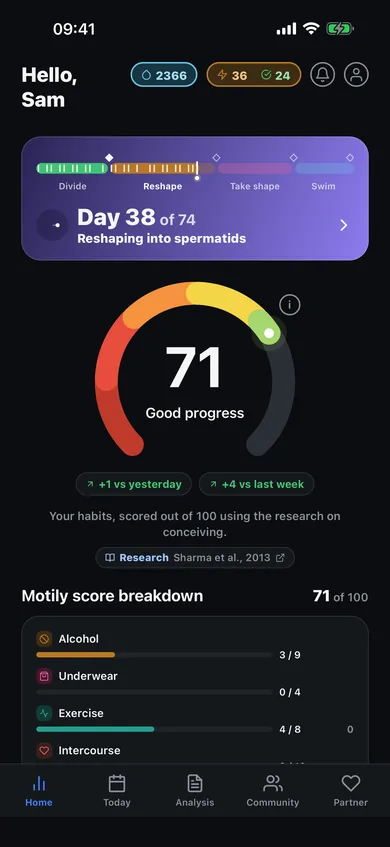
How sperm are made: the 74-day cycle
Sperm aren't stored up over a lifetime. They're produced continuously in the testes by a process called spermatogenesis, and the classic estimate of how long one cell takes to go from stem cell to sperm is about 74 days, measured by Heller and Clermont in 1964 using tracer-labeled testicular biopsies. A 2006 study using a stable-isotope method (Misell and colleagues) measured about 64 days on average from labeled stem cell to ejaculated sperm, a figure that covers spermatogenesis and the passage through the epididymis together, with considerable variation between men. After leaving the testis, sperm spend roughly one to two more weeks traveling through the epididymis, where they gain the ability to swim. So a fair summary is: two to three months from start to ejaculate, and the how-long guide walks through both studies.
Division and multiplication (roughly the first two to three weeks)
Spermatogonia, the stem cells lining the seminiferous tubules, divide repeatedly to build up the raw supply. Some of these divisions produce primary spermatocytes, the cells that go on to become sperm. This stage sets the volume for everything that follows, and it draws on the body's basic building blocks, which is why Motily weights steady nutrition and sleep here.
Reshaping into spermatids (roughly the next three to four weeks)
Primary spermatocytes undergo meiosis, a specialized cell division that halves the chromosome count and reshuffles genetic material. What emerges are spermatids: smaller, genetically distinct cells, each carrying half the DNA needed for an embryo. Because genetic material is being reorganized, some research suggests this is a more sensitive window for oxidative stress, which is where smoking, heavy drinking and chronic stress are thought to do most of their damage.
Taking shape (roughly the next few weeks)
Spermiogenesis is the physical transformation: a round spermatid grows a tail, compacts its DNA into a streamlined head and sheds most of its cytoplasm. By the end it looks like a sperm cell, though it still can't swim. Testicular temperature matters throughout the cycle, and this is the stage where consistently avoiding excess heat is thought to count most.
Learning to swim (roughly the final two weeks)
New sperm move into the epididymis, a long coiled tube where they gain motility and the biochemical readiness to fertilize an egg. There's no dramatic transformation left, just maintenance, so the job here is to keep a good stretch of habits going to the end.
Sources: Heller CG, Clermont Y. Kinetics of the germinal epithelium in man. Recent Progress in Hormone Research, 1964. Misell LM, et al. A stable isotope-mass spectrometric method for measuring human spermatogenesis kinetics in vivo. Journal of Urology, 2006.
How long until a change shows up
Because the cycle is continuous, the ejaculate on any given day is a mix of sperm that started developing across the previous two to three months. A habit you change today affects the cells that are at a sensitive stage now, and those cells won't be in an ejaculate for weeks. That has two practical consequences. First, a semen analysis taken two weeks into a new routine mostly reflects the old routine, so clinics commonly repeat tests about three months apart. Second, the fastest improvements in studies tend to come from removing an acute insult, such as heat exposure or heavy drinking, while diet and weight changes are slower and cumulative. Motily's journey is 74 days long for exactly this reason, and it starts a second cycle the day after the first ends. The 74-day timeline tool turns a start date into the date a retest can first show the change.
Sleep
Sleep is linked to sperm count and concentration, in both directions. In a cross-sectional study of 953 healthy young Danish men, those with the most sleep disturbance had sperm concentrations around 29% lower, and slightly fewer normally shaped sperm, than men with little disturbance. A longitudinal study of Chinese university students found an inverse U shape: compared with 7 to 7.5 hours, men sleeping 6.5 hours or less had around 26% lower sperm number, and men sleeping over 9 hours around 39% lower, with semen volume following the same pattern. Both are observational, so they show association rather than cause, but the direction is consistent; the sleep guide goes through both studies in detail.
What Motily does with it: 7 to 8 hours scores best, with consistent bed and wake times, and Apple Health can prefill the hours.
Sources: Jensen TK, et al. Association of sleep disturbances with reduced semen quality. American Journal of Epidemiology, 2013. Chen Q, et al. Inverse U-shaped association between sleep duration and semen quality. Sleep, 2016.
Alcohol
The clearest effect is from daily or heavy drinking. A 2017 systematic review and meta-analysis of 15 studies (more than 16,000 men) found that daily alcohol intake was associated with lower semen volume and poorer morphology, while occasional drinking wasn't consistently linked to any measure. Heavy drinking is also linked to lower testosterone. In other words, the dose and the pattern matter more than whether you drink at all; the alcohol guide has the dose curve.
What Motily does with it: an alcohol-free day scores full points, one drink costs a little, four or more costs the most.
Source: Ricci E, et al. Semen quality and alcohol intake: a systematic review and meta-analysis. Reproductive BioMedicine Online, 2017.
Smoking and vaping
Smoking is one of the most consistently confirmed lifestyle factors. A 2016 meta-analysis of 20 studies covering 5,865 men found smokers had lower sperm count, lower motility and poorer morphology than non-smokers, with larger effects in moderate and heavy smokers and in men attending fertility clinics. Smoking is also linked to higher sperm DNA fragmentation. Vaping is much less studied: a 2020 study of young Danish men, 1,221 of whom reported on e-cigarette use and only 25 of whom vaped daily, found daily e-cigarette users had lower total sperm counts than non-users (an adjusted estimate of 91 million against 147 million), a single observational finding that needs replication. The smoking and vaping guide covers both meta-analyses and the vaping study.
What Motily does with it: even light smoking is scored steeply, because there's no dose the evidence calls safe.
Sources: Sharma R, et al. Cigarette smoking and semen quality: a new meta-analysis. European Urology, 2016. Holmboe SA, et al. The association of reproductive hormones with sperm quality and e-cigarette and marijuana use in young men. Human Reproduction, 2020.
Heat
The testes sit outside the body because sperm production works best a couple of degrees below core temperature. Raising scrotal temperature, whether from saunas, hot baths, a laptop on the lap, long periods seated, or tight clothing, is linked to lower sperm production, and the effect is generally reversible. In a small 2013 study, ten healthy men who used a sauna (15 minutes at 80 to 90°C) twice a week for three months showed a marked fall in sperm count and motility, and every measure was back to baseline by the six-month follow-up. In a 2018 study of 656 men attending a fertility center, those who mostly wore boxers had 25% higher sperm concentration and 17% higher total count than those who wore tighter underwear. The heat guide has the sauna, hot tub, laptop and cycling studies one by one.
What Motily does with it: the daily check-in asks which heat exposures applied, and none scores best.
Sources: Garolla A, et al. Seminal and molecular evidence that sauna exposure affects human spermatogenesis. Human Reproduction, 2013. Mínguez-Alarcón L, et al. Type of underwear worn and markers of testicular function among men attending a fertility center. Human Reproduction, 2018.
Exercise
Moderate, regular physical activity is linked to better semen quality, and extremes in either direction are linked to worse. A 2019 systematic review and meta-analysis of 32 studies found that most results pointed to no major effect of physical activity on semen quality, though recreational activity may be linked to better sperm concentration and progressive motility, while elite-level training and cycling were linked to poorer results on some measures, plausibly through heat, pressure and hormonal changes at very high training loads. The threshold for harm is high; for most men the practical risk is doing too little. The exercise guide has the studies, including the cycling one.
What Motily does with it: 25 to 45 minutes of moderate activity a day scores best, and a very long single session scores slightly lower rather than being penalized.
Source: Ibañez-Perez J, et al. An update on the implication of physical activity on semen quality: a systematic review and meta-analysis. Archives of Gynecology and Obstetrics, 2019.
Weight
Body weight is linked to sperm count in a J-shaped curve. A 2013 collaborative meta-analysis of 21 studies and 13,077 men found that, compared with men of normal BMI, overweight men had 1.11 times the odds of oligozoospermia (low sperm count) or azoospermia (no sperm), obese men 1.28 times, and men with a BMI of 40 or over 2.04 times; underweight men showed a small rise that was not statistically significant. Excess body fat is thought to act through lower testosterone, higher estrogen and increased scrotal temperature. The weight guide has the meta-analysis and the weight-loss trial.
What Motily does with it: your height and weight from the onboarding quiz feed BMI into your Motily score, and the tip is gradual change, not crash dieting.
Source: Sermondade N, et al. BMI in relation to sperm count: an updated systematic review and collaborative meta-analysis. Human Reproduction Update, 2013.
Stress
The evidence here is mixed, and honest copy should say so. A 2014 study of 193 men found those reporting two or more stressful life events in the past year had lower motility and a lower share of normal-shaped sperm, and job strain was linked to lower testosterone. A 2016 study of 1,215 Danish men found self-rated stress was associated with lower semen quality mainly at the highest stress levels, with no clear effect at moderate levels. The proposed mechanism runs through the stress hormone cortisol suppressing testosterone production; the stress guide sets out what the studies can and can't say.
What Motily does with it: it asks how many stressful episodes you had and how you felt, and treats mood as a trend, never a single bad day.
Sources: Janevic T, et al. Effects of work and life stress on semen quality. Fertility and Sterility, 2014. Nordkap L, et al. Psychological stress and testicular function: a cross-sectional study of 1,215 Danish men. Fertility and Sterility, 2016.
Nutrition and supplements
Dietary pattern is the strongest nutritional signal. A 2017 systematic review of observational studies found that diets rich in vegetables, fruit, fish, seafood, poultry, cereals and low-fat dairy were associated with better semen quality, while diets high in processed meat, full-fat dairy, sweets, sugary drinks and alcohol were associated with worse. Specific nutrients that come up repeatedly are omega-3 fatty acids, antioxidants (vitamins C and E, lycopene), zinc, selenium and folate, all of which come from food; the diet guide lists the foods. Supplements are less clear: the 2022 Cochrane review of antioxidant supplements for male subfertility found they may increase live birth and clinical pregnancy rates, but rated the evidence very low to low certainty because of risk of bias, poor reporting and small trials, and the live birth effect disappeared when trials at high risk of bias were removed. The supplements guide looks at CoQ10, zinc, folate, vitamin D and omega-3 individually.
What Motily does with it: the nutrition check-in asks what share of your food was whole and unprocessed, and whether you took a supplement, and it doesn't sell you one.
Sources: Salas-Huetos A, et al. Dietary patterns, foods and nutrients in male fertility parameters and fecundability. Human Reproduction Update, 2017. de Ligny W, et al. Antioxidants for male subfertility. Cochrane Database of Systematic Reviews, 2022.
Caffeine
Coffee and tea in ordinary amounts don't appear to affect semen quality. A 2017 systematic review of 28 observational studies covering nearly 20,000 men found semen quality didn't seem affected by caffeine from coffee, tea or cocoa in most studies, though cola and other caffeinated soft drinks were linked to lower volume, count and concentration, and some studies linked caffeine to sperm DNA breaks. The soft-drink finding is hard to separate from sugar and overall diet, and the authors called the overall evidence inconsistent. The caffeine guide has the cola study.
What Motily does with it: up to two or three cups a day isn't penalized; more than that is scored down slightly.
Source: Ricci E, et al. Coffee and caffeine intake and male infertility: a systematic review. Nutrition Journal, 2017.
Hydration
This is the factor with the least direct evidence, and Motily says so in the app. Semen is mostly water, so it's reasonable to expect that dehydration affects semen volume, but there's no good sperm-specific study to cite. The 2 to 3 liters a day the app suggests is general hydration guidance, not a fertility finding, which is why hydration carries the lowest weight in the daily score.
What Motily does with it: hydration is worth 6 of the 100 daily points, the smallest of the eight categories.
Ejaculation frequency
The old advice to save up for ovulation has been overtaken. The American Society for Reproductive Medicine's committee opinion on optimizing natural fertility says pregnancy rates are highest with intercourse every one to two days during the fertile window (the five days before ovulation plus ovulation day), and that two to three times a week gives nearly the same results. A 2016 study that had 20 men ejaculate daily for two weeks found volume, concentration and total motile count fell, mostly in the first three days before leveling off, while motility and morphology were unchanged, and several studies link shorter abstinence to lower sperm DNA fragmentation. Long gaps, in short, don't build a better sample; the frequency guide explains why.
What Motily does with it: the intercourse check-in tracks timing, and the partner's fertile window can appear on the Today tab if she chooses to share it.
Sources: Practice Committee of the American Society for Reproductive Medicine. Optimizing natural fertility: a committee opinion. Fertility and Sterility, 2022. Welliver C, et al. Analysis of semen parameters during 2 weeks of daily ejaculation. Translational Andrology and Urology, 2016.
What a semen analysis measures
A standard semen analysis reports volume, sperm concentration, total count, total and progressive motility, and often morphology, vitality and pH. The WHO laboratory manual, 6th edition (2021), gives lower reference limits drawn from the 5th centile of men whose partners conceived within 12 months: volume 1.4 mL, concentration 16 million per mL, total count 39 million, total motility 42%, progressive motility 30%, vitality 54% and normal forms 4%. Falling below a limit means below reference, not infertile, and results vary between samples from the same man, which is why clinics repeat the test (the retest guide covers when). The FAQ has the full table, the semen analysis guide explains each line of a report, and the checker tool compares your numbers against the limits in your browser.
What Motily does with it: each value you enter is shown against the WHO limit and tracked across reports, and the app leaves interpretation to your clinician.
Source: World Health Organization. WHO laboratory manual for the examination and processing of human semen, 6th edition. 2021.
When to see a doctor
The NHS advises seeing a GP if you haven't conceived after a year of regular unprotected sex, and sooner if your partner is 36 or over or either of you has a known fertility issue; ASRM uses six months when the woman is 35 or older. Go sooner if you have a varicocele, a history of undescended testicle, mumps after puberty, groin or testicular surgery, chemotherapy or radiotherapy, or past testosterone or anabolic steroid use. Around half of couples' fertility difficulties involve a male factor, so a semen analysis is a normal first step, not a last resort. Age matters for men too, more gradually; the age guide has the numbers.
Source: NHS. Infertility.
Correction, 11 September 2026. This page previously attributed the 74-day figure to Heller and Clermont's 1963 paper. That paper estimated about 64 days; the 74-day figure comes from their 1964 paper, which is now the cited source. The figure itself is unchanged.
Correction, 8 October 2026. Corrected the exercise review (most studies found no major effect; recreational activity was linked to better concentration or progressive motility, elite training and cycling to poorer results), the vaping study (1,221 men answered on e-cigarettes, 25 vaped daily, and the figures are adjusted estimates, not medians), the antioxidant review (updated to the 2022 Cochrane review), the ASRM timing advice (two to three times a week does nearly as well; it does not say every two to three days) and the 2017 diet review's food list (cereals, not whole grains and nuts).