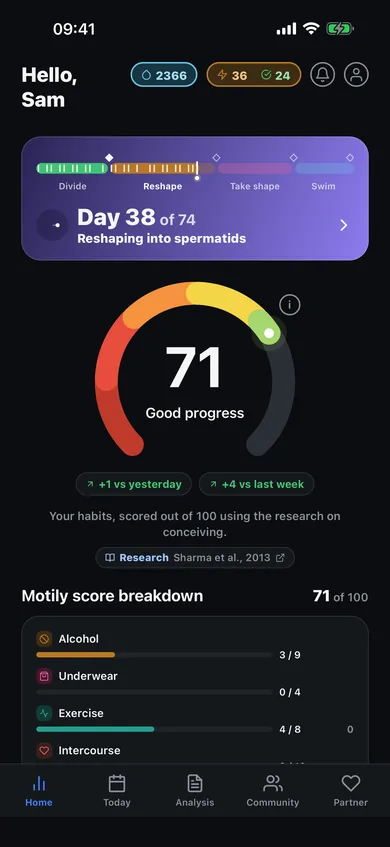
About two to three months. One cycle of sperm production (spermatogenesis) takes roughly 74 days in men, a figure from Heller and Clermont's 1964 tracer study, and a 2006 isotope study found new sperm reached the ejaculate after an average of 64 days, epididymal passage included, with considerable variation between men. Sperm spend their final one to two weeks in the epididymis learning to swim. So a change you make today reaches the ejaculate in roughly 10 to 12 weeks, and the UK's NICE guideline has clinics repeat an abnormal semen analysis three months later for exactly this reason. Heat is the change with the clearest recovery data; drinking, diet and sleep follow the two-to-three-month cycle, and weight is slower and cumulative.
Where the 74 days comes from
Heller and Clermont injected volunteers with a tracer that labeled dividing cells, then took testicular biopsies at intervals and watched the labeled cells move through the stages of development. In their 1964 analysis, the time from the earliest labeled stem-cell division to a finished sperm was about 74 days, and the figure has been the textbook number since. In 2006 Misell and colleagues did a gentler version: 11 healthy men drank heavy water daily for three weeks, the label was built into the DNA of new cells, and its first appearance in ejaculated sperm was tracked. That took an average of 64 days, a figure that covers spermatogenesis and the passage through the epididymis together, with considerable variation between men. Both studies agree on the shape of the thing: sperm are made continuously, in overlapping waves, over a couple of months. Motily uses 74 because it is the classic figure and the conservative one; the app's phase boundaries are a working model rather than biological cut-offs, and the science page explains each phase.
What that means for a test
The ejaculate on any given day is a mix of sperm that started developing at different points across the previous two to three months. If you changed something a fortnight ago, most of the sperm in today's sample were already halfway through their development under the old routine. That is why a semen analysis taken soon after a change mostly reflects what you were doing before it, and why the guidance is to wait. NICE's wording: if the first result is abnormal, "undertake repeat confirmatory tests ideally 3 months after the initial analysis to allow time for the cycle of spermatozoa formation to be completed", with an exception for azoospermia or a very low count, where the repeat should happen as soon as possible because the next steps are different. The American Urological Association and ASRM guideline adds that two analyses a month apart are worth having when the first is abnormal, because semen parameters "are highly variable biological measures and may vary substantially from test to test".
Which changes show fastest
The factors with the best recovery data are the ones where an acute insult is removed. In the 2013 sauna study, ten men whose sperm count and motility fell during three months of twice-weekly sauna were back to baseline by the six-month follow-up. In the 2007 hot tub study, five of 11 men improved within three to six months of stopping. Ejaculation timing changes a sample within days, which is why labs specify a 2 to 7 day abstinence window. Weight is at the other end: in a 2022 Danish trial, sperm concentration rose about 1.5-fold after eight weeks of dieting, and the gain lasted only in men who kept the weight off over the following year. Diet, sleep and drinking sit in the middle, with no direct recovery studies; for those the two-to-three-month figure is an inference from the cycle. The main guide gives a timeframe for every factor.
Why not sooner, and why not longer
Not sooner, because the cells that a sample contains were committed weeks ago; a change can't reach them. Not longer, because after one full cycle plus the epididymal fortnight, every sperm in the ejaculate developed under the new routine, so there is nothing left for time alone to add. What a second cycle adds is consistency: a habit held for 74 days is one the next 74 days can build on, which is why the app starts a new cycle the day after the first ends rather than declaring the job done.
Fever, illness and the three-month shadow
The same logic runs in reverse. A high fever, a bad flu, a course of some medications or a heavy month can pull a semen analysis down two to three months later, even if you feel fine on the day. When a result is lower than expected, think back over the previous quarter before you read anything into it, and mention anything notable to whoever ordered the test.
What to do
- Pick a start date and put a semen analysis in the calendar for 12 weeks later. The 74-day timeline tool does the arithmetic, and the 74-day kit page sets out a home-test version.
- Make the changes you can make at once early: heat out, drinking down, smoking stopped. Heat is the one with recovery data inside three to six months; the others follow the production cycle.
- Keep the slow changes going past the first test. Diet and weight are cumulative, and the weight-loss gains only held in men who kept the weight off.
- Use the same abstinence window (2 to 7 days) and the same lab for every test, so the trend means something.
- If your first result showed no sperm or a very low count, don't wait three months; ask for the repeat straight away.
Related guides
Sources
- Heller CG, Clermont Y. Kinetics of the germinal epithelium in man. Recent Progress in Hormone Research, 1964.
- Misell LM, et al. A stable isotope-mass spectrometric method for measuring human spermatogenesis kinetics in vivo. Journal of Urology, 2006.
- NICE. Fertility problems: assessment and treatment (NG257). 2026.
- American Urological Association and ASRM. Diagnosis and treatment of infertility in men: AUA/ASRM guideline. 2020, amended 2024.
- Garolla A, et al. Seminal and molecular evidence that sauna exposure affects human spermatogenesis. Human Reproduction, 2013.
- Shefi S, et al. Wet heat exposure: a potentially reversible cause of low semen quality in infertile men. International Braz J Urol, 2007.
- Andersen E, et al. Sperm count is increased by diet-induced weight loss and maintained by exercise or GLP-1 analogue treatment: a randomized controlled trial. Human Reproduction, 2022.
- Chung E, et al. Sixth edition of the World Health Organization laboratory manual of semen analysis: updates and essential take away for busy clinicians. Arab Journal of Urology, 2023.
Correction, 11 September 2026. This page previously attributed the 74-day figure to Heller and Clermont's 1963 paper. That paper estimated about 64 days; the 74-day figure comes from their 1964 paper, which is now the cited source. The figure itself is unchanged.
Correction, 8 October 2026. Heavy drinking was listed as one of the fastest changes to show, but there is no direct study of recovery after cutting down. Heat is the change with recovery data. The to-do list made the same claim for drinking and smoking and now matches.