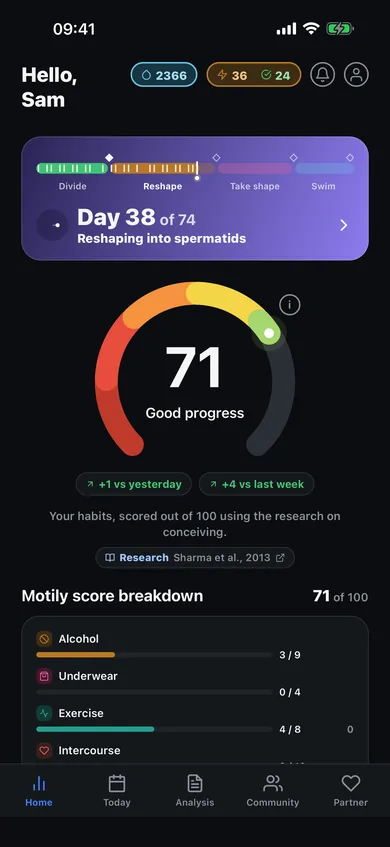
One cycle of spermatogenesis takes roughly 74 days (Heller and Clermont, 1964), and sperm then spend about one to two more weeks in the epididymis learning to swim. A change you make on day 1 shows in a test taken around day 74, and more fully a couple of weeks after that. That is why the UK's NICE guideline repeats an abnormal semen analysis three months later, and why Motily's journey is 74 days long. The phases below use the same day boundaries as the app.
Your 74 days
Every date on this page is worked out from the start date you pick, in your browser. It defaults to today; change it to the day you began a change, or the day you started logging, and the phases, the dates and the retest day all move with it.
The four phases
These are the phases the app walks you through, with the habits it weights in each. The biology is continuous and the boundaries are approximate; the science page explains what happens in each.
| Phase | Days | What happens | Habits the app weights here |
|---|---|---|---|
| Building the supply | 1 to 17 | Stem cells divide to build up the supply | Nutrition, sleep |
| Splitting the cells | 18 to 42 | Meiosis: each cell divides twice, into four cells with half the DNA | Substances, mood and stress |
| Growing tails | 43 to 60 | Round spermatids grow a tail and compact their DNA | Heat, exercise |
| Learning to swim | 61 to 74 | Sperm pass through the epididymis and gain motility | Nutrition, hydration |
Strictly, the 74 days covers sperm production in the testis, and the trip through the epididymis adds about one to two weeks after it. The app and this table fold that trip into the last phase so the journey stays at 74 days, which is why a test a couple of weeks after day 74 shows a change more fully.
How to use the dates
- Pick the day you started a change (or today) as day 1.
- Book a semen analysis for around day 74 or a little after; a test much earlier mostly measures sperm that developed under the old routine.
- If you already have an abnormal result, the retest date NICE recommends is about three months after it, which lands in the same place.
- When the cycle ends, start the next one the following day. Consistency across two cycles is what carries a good stretch of habits all the way through.
Where 74 comes from, and why it's approximate
Heller and Clermont measured about 74 days from stem-cell division to finished sperm in 1964 using labeled biopsies. A 2006 isotope study found new sperm reached the ejaculate after an average of 64 days, epididymal passage included, with considerable variation between men. Motily uses 74 because it is the classic and conservative figure. The how-long guide covers the studies and the retesting rules.
Embed this timeline
Writing about sperm health, or running a clinic or forum page? You can use this chart. Copy the code below into your page; it links back here so readers can work out their own dates.
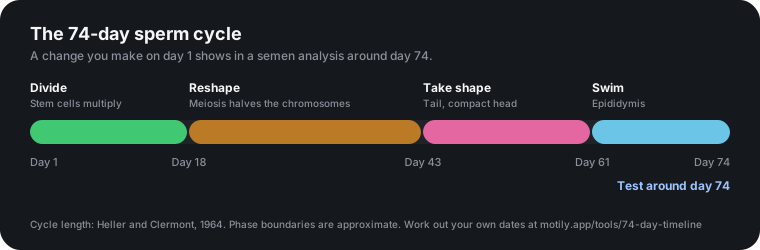
<a href="https://motily.app/tools/74-day-timeline/"><img src="https://motily.app/assets/embed/74-day-timeline.svg" width="760" height="250" style="max-width:100%;height:auto" alt="The 74-day sperm cycle in four phases: divide (days 1 to 17), reshape (18 to 42), take shape (43 to 60) and swim (61 to 74). Source: Motily"></a>
<p>Source: <a href="https://motily.app/tools/74-day-timeline/">74-day sperm timeline, Motily</a></p>
Related
Sources
- Heller CG, Clermont Y. Kinetics of the germinal epithelium in man. Recent Progress in Hormone Research, 1964.
- Misell LM, et al. A stable isotope-mass spectrometric method for measuring human spermatogenesis kinetics in vivo. Journal of Urology, 2006.
- NICE. Fertility problems: assessment and treatment (NG257). 2026.
Correction, 11 September 2026. This page previously attributed the 74-day figure to Heller and Clermont's 1963 paper. That paper estimated about 64 days; the 74-day figure comes from their 1964 paper, which is now the cited source. The figure itself is unchanged.
Correction, 8 October 2026. The epididymis stage comes after the roughly 74 days of production in the testis, not inside it. The opening line is corrected and a note under the phase table explains how the app folds it into the last phase.