Heavy and daily drinking is linked to poorer semen quality; occasional drinking isn't consistently linked to anything. A 2017 meta-analysis of 15 studies and more than 16,000 men found daily alcohol intake was associated with lower semen volume and a lower share of normally shaped sperm, while occasional drinking wasn't. A 2014 study of 1,221 young Danish men saw effects from about 5 units a week upward, clearest above 25 units, and men drinking more than 40 units a week had 33% lower sperm concentration than men drinking 1 to 5 units. Because sperm take about 74 days to develop, a change in drinking shows in a test two to three months later.
What counts as heavy
The studies measure alcohol in units or drinks per week, and the pattern matters as much as the total. In the 2017 meta-analysis (Ricci and colleagues, Reproductive BioMedicine Online) the consistent finding was for men who drank every day: lower volume and poorer morphology, with no consistent effect on concentration or motility across studies, and no consistent effect at all for men who drank occasionally. The Danish study (Jensen and colleagues, BMJ Open) is the one with a dose curve. In healthy 18 to 28 year olds, semen quality fell gradually from about 5 units a week, was most clearly reduced above 25 units a week, and men reporting more than 40 units a week had 33% lower sperm concentration than men on 1 to 5 units, with total count and the share of normal-looking sperm also lower. Heavy drinking was also associated with higher testosterone and lower sex hormone-binding globulin, a hormone pattern the authors read as alcohol changing how the testes are regulated. A UK unit is 10 mL of pure alcohol: roughly half a pint of ordinary beer, a small glass of wine, or a single measure of spirits, so 25 units a week is around 10 pints or two and a half bottles of wine.
What alcohol does, as far as anyone knows
The proposed mechanisms are hormonal and oxidative. Alcohol acts on the hypothalamus and pituitary, which regulate the testes, and the shifted hormone pattern in the Danish study is read as a sign of that; alcohol also raises oxidative stress, which the developing sperm cell is thought to be particularly exposed to while its genetic material is being reorganized in the middle of the cycle. These are plausible pathways rather than proven ones in men, and the human studies are observational, so they show association rather than cause. One thing worth saying plainly: all of them found the effect at the heavy end, and none found a benefit from moderate drinking either.
Binge drinking versus daily drinking
The evidence separates the two less cleanly than you might want. The meta-analysis flags daily drinking; the Danish study measured a typical week and also asked about binge episodes and drinking in the previous month, and found no strong link between semen quality and either recent drinking or binge drinking, while the habitual weekly total tracked semen quality closely. The safest reading is that the long-run weekly total is what matters, and that a heavy weekend adds up to the same total as a drink every night.
How long until cutting back shows in a test
No study has followed men after they reduce drinking and measured sperm at intervals, so the timing is an inference from the production cycle. One cycle of sperm production takes about 74 days, and sperm then spend one to two weeks in the epididymis, so a semen analysis taken two to three months after you change your drinking is the first one that mostly reflects the new pattern. A test taken two weeks in mostly reflects the old one. The 74-day timeline tool gives you the date, and the how-long guide explains the cycle.
What about while she's pregnant, or during IVF?
Sperm quality is only relevant up to conception, so the reason to keep drinking moderate through fertility treatment is the same as before it: the sample used in an IUI or IVF cycle was made in the previous two to three months. After conception, your drinking has no route to the pregnancy, though it has plenty of other consequences worth thinking about.
What to do
- Count a normal week in units. If it is 25 or more, that is the number the evidence flags and the place to start.
- Make most days alcohol-free. Daily drinking is the pattern the meta-analysis singles out, and the app scores an alcohol-free day full points.
- Keep the rest moderate: a few drinks across the week, not a few every night.
- Put a semen analysis in the calendar for three months after the change, so the test reflects the new pattern.
- If cutting back is hard, that's a conversation worth having with a GP; the NHS has alcohol advice and support.
Common questions
Does one night of heavy drinking affect sperm?
The Danish study of 1,221 men found binge drinking wasn't independently linked to semen quality; the habitual weekly total was what tracked it. A heavy night on its own is unlikely to stand out in a test, but regular heavy weekends add to the weekly total, which is the number the evidence flags.
How many units a week is safe for sperm?
No study has set a safe limit. In the Danish study, effects on semen quality appeared from more than 5 units a week and were clearest above 25. The 2017 meta-analysis singled out daily drinking. A low weekly total with most days alcohol-free is the pattern least linked to poorer semen quality.
Does alcohol affect testosterone?
In the Danish study, men who drank more in the week before their visit had higher testosterone and free testosterone and lower SHBG, a protein that carries testosterone in the blood. It is read as a sign that alcohol shifts the hormones that regulate the testes, but it is an association, not proof of the mechanism.
How long after cutting back does sperm improve?
No study has measured it directly. Sperm take about 74 days to make and then spend one to two weeks in the epididymis, so a test two to three months after the change is the first that mostly reflects it. The retest guide covers timing, and if a first result was low, the low sperm count guide covers the other causes worth checking.
Does Motily track alcohol?
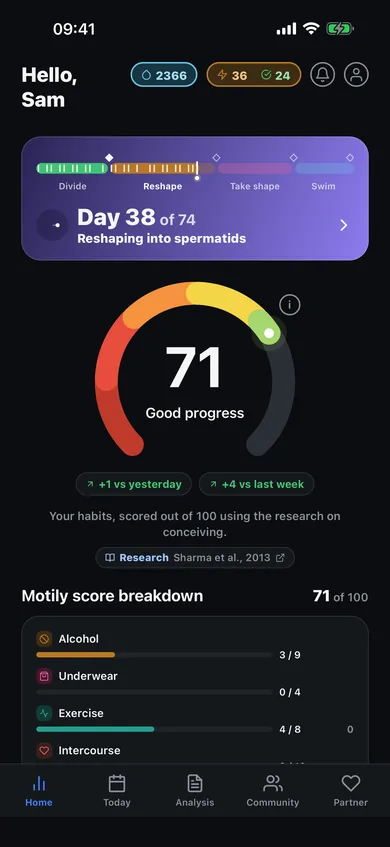
Yes. The daily check-in asks about alcohol under Substances, and an alcohol-free day scores full points. Cannabis is covered in its own cannabis guide.
Related guides
Sources
- Ricci E, et al. Semen quality and alcohol intake: a systematic review and meta-analysis. Reproductive BioMedicine Online, 2017.
- Jensen TK, et al. Habitual alcohol consumption associated with reduced semen quality and changes in reproductive hormones; a cross-sectional study among 1221 young Danish men. BMJ Open, 2014.
- Heller CG, Clermont Y. Kinetics of the germinal epithelium in man. Recent Progress in Hormone Research, 1964.
- NHS. Alcohol advice.
Correction, 8 October 2026. The 33% figure in the 2014 Danish study is lower sperm concentration in men drinking more than 40 units a week, not lower total count, and the paper reports no 51% figure for morphology. Both sentences are corrected.